


By Andrew Daly
Cover photo by Chuck Flores
Though he was born in Birmingham, Alabama, and spent time in Wilmington, North Carolina, Dale Watson has called Marshall, Texas, home for some time. He loves the place, the vibes, and the scene.
“My fan base has grown so much I’m always amazed,” Watson says of his Texas following. “I’m not packing out stadiums or Billy Bobs, but I have a great fan base that knows I’m accessible and grateful for their loyalty.”
As for what keeps fans young and old drawn to Watson’s blend of outlaw country and rockabilly, he shrugs, saying, “One fan at a time. My fans have seen me at my highest and my lowest and, frankly, saved my life.”
“Many fans have become close friends,” he says. “And at the very least, I think it’s fair to say I do not have a fan base; I have a friend base.”
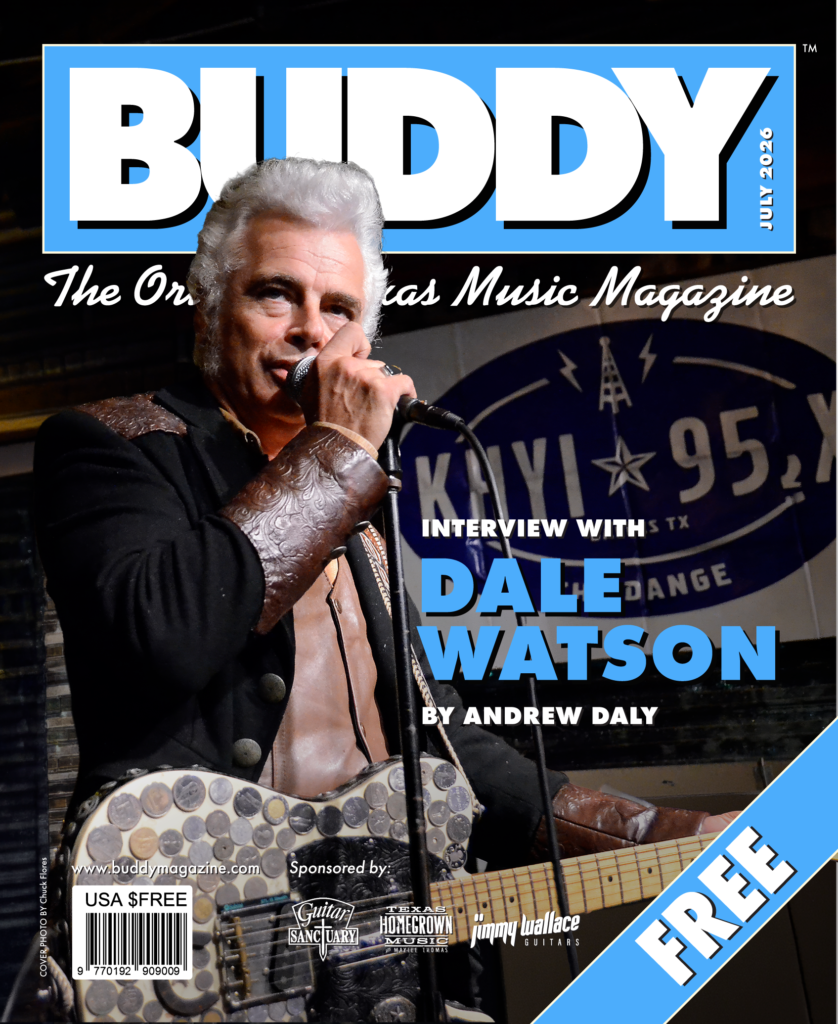
Dale Watson, July 2026. Cover photo by Chuck Flores.
This is good news, as Watson has his latest record out, 2026’s Unwanted. “I’d like to think it’s grown,” Watson says of his process. “But I don’t think I’ve changed much in that regard. I get inspired, and I write. I thank God for the process.”
When you write new music, do you primarily write on guitar? What does that process look like for you?
I write mostly while driving and on stage. Very rarely do I write intentionally in a sit-down setting. For this album, Unwanted, the first song that came to me was “Willie, Waylon & Whiskey.”
It was written in a stage in San Antonio [Texas], inspired by a big ol boy standing in front of me wearing a shirt that said Willie Waylon Whiskey on it. And “Outlive Me” was one I wrote after one of my two dogs was hit by a car in front of me.
And then there’s “If I Can,” which was inspired by my own mortality and by my desire to let my wife, Celine, know my feelings. And “Cadillac” is the only co-write. I started writing it, and my friend, the late Michael Henderson.
He was an amazing musician and writer, and he helped me finish it. He played slide guitar and harmonica on my acoustic album on which the song originally came out.
What’s your favorite song from your new record, and why? How do you compare your new music to your older work?
“If I Can” is my favorite. It deals with the subject of mortality, which Celine hates to talk about, but I believe it will give comfort after the fact. So, obviously, my new music often has overtones of being older, written in or between the lines; that’s the only comparison I can think of between my new music and my older work.
How do you view the modern country and rockabilly scenes? Are they in a good place?
I have more hope for modern country with people like Sierra Ferrell, Charlie Crockett, Joshua Walker, and Sunny Sweeney. There is always going to be the shitty bro-country or flavor-of-the-month country-rapper crap, but the real stuff is at least being heard more.
As far as the rockabilly scene, it’s alive and well. I just played Viva Las Vegas, which is the biggest Rockabilly Festival in the world, and internationally, the genre is thriving and evolving naturally. I say that because there are subgenres being invented.
This is great for diversity – but it all sticks to the root of rockabilly. Examples are surf rockabilly, Western swing rockabilly, and, of course, inspired by Reverend Horton Heat, psychobilly.
Some say those scenes lack authenticity. Can you understand that or agree?
I might understand the judgment based on the visual aspect. It’s easy to judge a book by its cover, but if you really listen to these artists, they definitely have authentic roots. They live it. A great example is Wayne Hancock.
He’s received an Ameripolitan Award for Honky Tonk Male and Rockabilly Male. Some say he is just imitating Hank Williams. But if you listen, you can easily hear the difference, and Wayne’s songs are as original as it gets.
James Hand, Wayne Hancock, and Hank Williams. I can tell who’s singing from the first note. Just because these artists stick close to the root doesn’t mean they aren’t authentic.
What are your favorite Texas spots to play when you’re on tour, and why?
I’m a fan of the dance halls like Luckenbach, Gruene and, of course, the Broken Spoke. But lately, listening rooms and theaters have opened up a new experience for me. Places like the Red Bird, The Kessler, and The Mucky Duck give me a chance to showcase my more intimate songs.
What can you say about the Texas music scene as far as country and rockabilly go, and what keeps it vibrant?
I believe that Texas has always been a place that encourages country and rockabilly. By that, I mean there is a supportive audience. So that’s half the battle. The audience inspires the vibrancy and vice versa. As long as there are people coming to the shows, I think it makes the artist really strive to create and grow.
Do you ever get bored with the music business or think that listeners aren’t as engaged with new music from older artists as they used to be?
I’m never bored with the shows, and the business of music has always been the same. I don’t like the money aspect of music, but it’s a necessity for touring and recording. As far as listeners and older artists like me, I’ve got no complaints on my end.
I get compliments from young audience members all the time, and I’ll take that. Kris Kristoffersson once told an interviewer, when asked before the show if he was going to play new music or just his old stuff, his reply was, “I didn’t realize music had a shelf life.”
How do you look back on your career? Any regrets? What are you proudest of?
Tons of regrets. Too many to mention. My life is full of mistakes and regrets, and it’s hard not to dwell on them, but I try to concentrate on the present. Not the future. The thing I’m most proud of is The Ameripolitan Awards. It’s an award show I started back in 2014.
It awards honky tonk, Western swing, rockabilly, and outlaw artists, venues, festivals, and DJs. It’s meant to encourage roots-oriented artists and industry people to keep the roots in their music and not sell out to the big guys. We’ve missed a couple of years in between but will pick it back up in Austin in April of 2027.
—


