


COVER STORY: Treaty Oak Revival frontman talks West Texas Degenerate, arena tour, staying independent
Written by: Ian Saint
Treaty Oak Revival’s December 20 headlining show at Fort Worth’s Dickies Arena is sold out. That’s despite them having already sold out Irving’s 8,000-capacity Pavilion at Toyota Music Factory, only 35 miles away, just last August.
And that’s a far cry from 2023, when their DFW headlining dates took place at House of Blues Dallas and Billy Bob’s Honky Tonk.
The sold-out Dickies Arena concert is in between arena shows at Oklahoma City’s Paycom Center on December 19, and Houston’s Toyota Center on New Year’s Eve. (As of press time, tickets are still available to those shows.) Then in February, Treaty Oak Revival will embark on a 25-cities arena headlining tour.
The brisk upgrade in venue sizes that Treaty Oak Revival has played over the last couple years is remarkable for an independent band formed seven years ago in Odessa, Texas. Band members have since moved from Odessa, but remain in Texas and Oklahoma.
New album West Texas Degenerate is Treaty Oak Revival’s third self-released LP, following 2023’s Have a Nice Day and 2021 debut No Vacancy. Dropped on Black Friday, the album debuted at #1 on Billboard’s Top Rock Albums and Americana/Folk Albums charts, #2 on Billboard’s Top Rock & Alternative Albums chart, #3 on Top Country Albums, and #21 on Billboard’s all-genre Top 200 Albums chart.
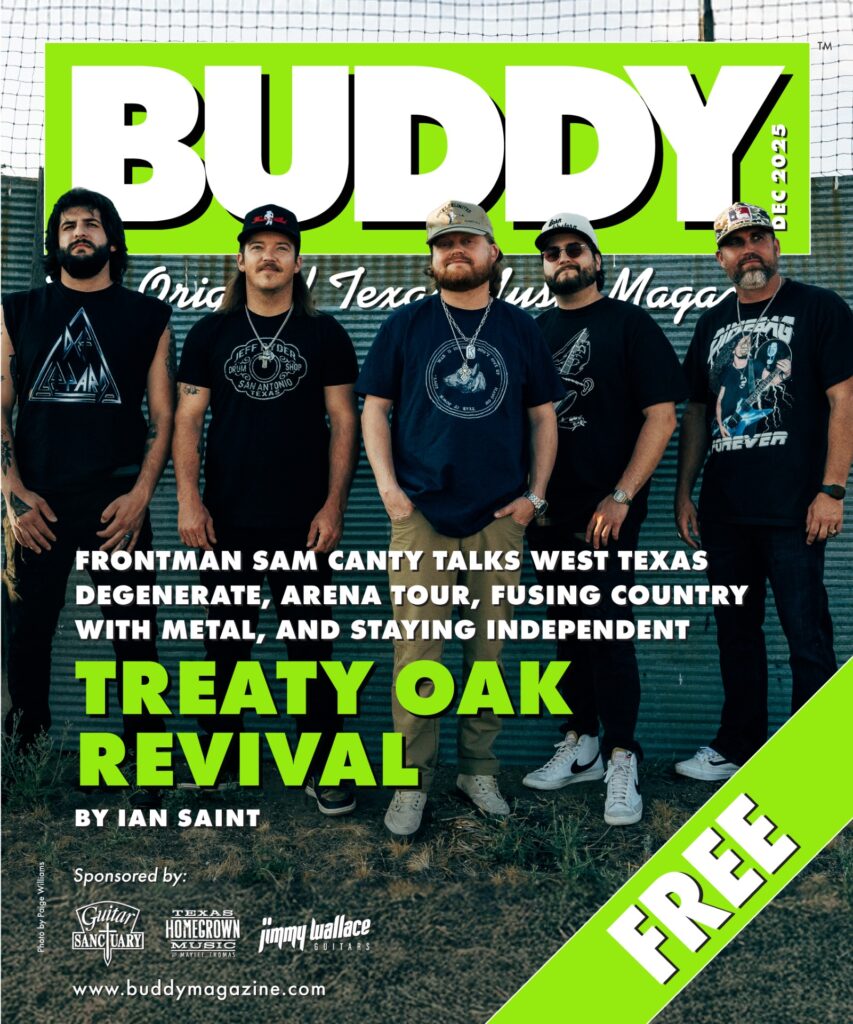
Not to sugarcoat the downsides of Treaty Oak’s rapid ascent. Original bassist Andrew Carey exited in June, citing that “Touring and rocking a little too hard has done a number on back, body, and mind.” Carey’s replacement Dakota Hernandez joins frontman & primary songwriter Sam Canty, rhythm guitarist & harmony singer Lance Vanley, lead guitarist Jeremiah Vanley, and drummer Cody Holloway in their current ensemble, depicted on Buddy’s December 2025 cover.
The band tried a distribution deal with Interscope Records earlier this year. That produced the single “Bad State of Mind,” now featured on West Texas Degenerate, which led to their first network TV appearance (“Jimmy Kimmel Live!”) Then they released The Talco Tapes, a collection of eight songs plus a Goo Goo Dolls cover re-recorded in stripped-down arrangements. When it came time to put out their third studio album, however, Treaty Oak Revival returned to self-releasing for West Texas Degenerate.
So, they’ve mostly never had record label support, they don’t have family ties or geographic proximity to the entertainment industry, and they aren’t whippersnappers for the Instagram age — in fact, Jeremiah Vanley (who’s wearing the badass Dimebag Darrell shirt in our cover photo) is the 42 year-old uncle of Lance Vanley. What is the formula for their skyrocketing rise in popularity?
Perhaps the answer is that Treaty Oak Revival’s model isn’t too formulaic or premeditated. West Texas Degenerate placing high on both the alternative and country charts speaks to the breadth of their sound. If they’d signed to one of the major record companies — Billboard reported all three courted them — they likely would’ve been marketed to target one genre.
They don’t strive for glamour or perfection, either. Their lyrics often lay bare their flaws, insecurities, and demons — such as on new track, “Withdrawals,” which was inspired by Canty’s real-life hellacious (and hallucinatory) battle with delirium tremens as he quit alcohol. He’s now a sober, married dad; and “Bad State of Mind” was written shortly after his infant son was born, and worries about slipping back into destructive habits crossed his mind.
Plus, they’re just plain fun to be around. In conversation with Canty, who’s also the band’s primary songwriter, I find that he still doesn’t take himself too seriously. As he explains to me why Treaty Oak Revival ultimately decided to turn down major record labels, Canty remarks that “no one of us is really the big star, we treat our entire crew like we’re all stars and part of the band.”
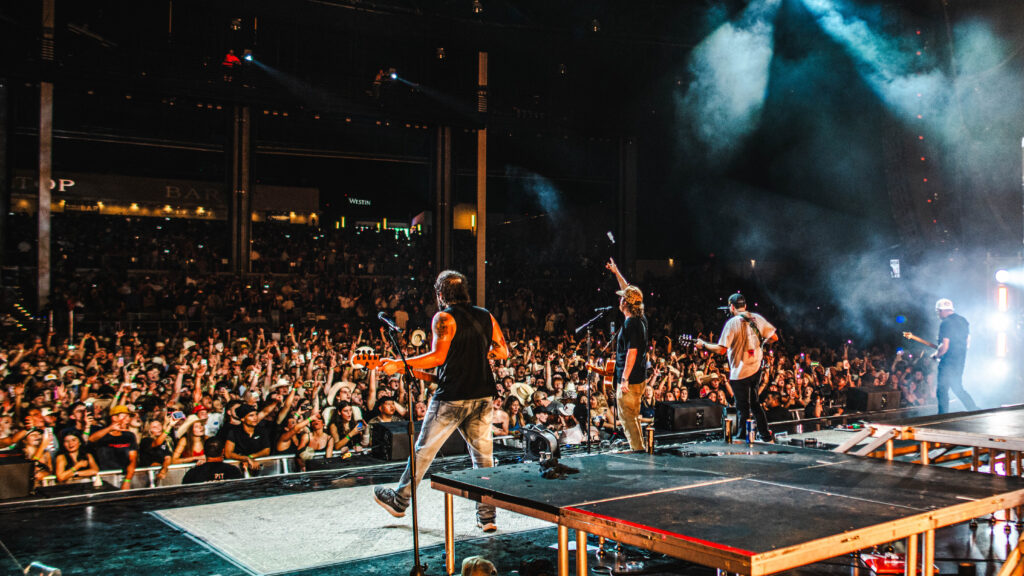
That’s a spirit reflected in their new music video, “Blue Star,” that was filmed in Texas. Ex-bassist Carey, who played on the track but departed before the video shoot, commented on Facebook: “Aw that’s so cool. Cameos of literally everyone who’s ever been involved with the band. Friends, family members, people we went on tour with, crew members, other artists.” The teacher is played by musician Mitchell Ferguson from Dallas, who has frequently played shows with Treaty Oak; and his photographer, Austin Graf, snapped the Irving concert photo in our article.
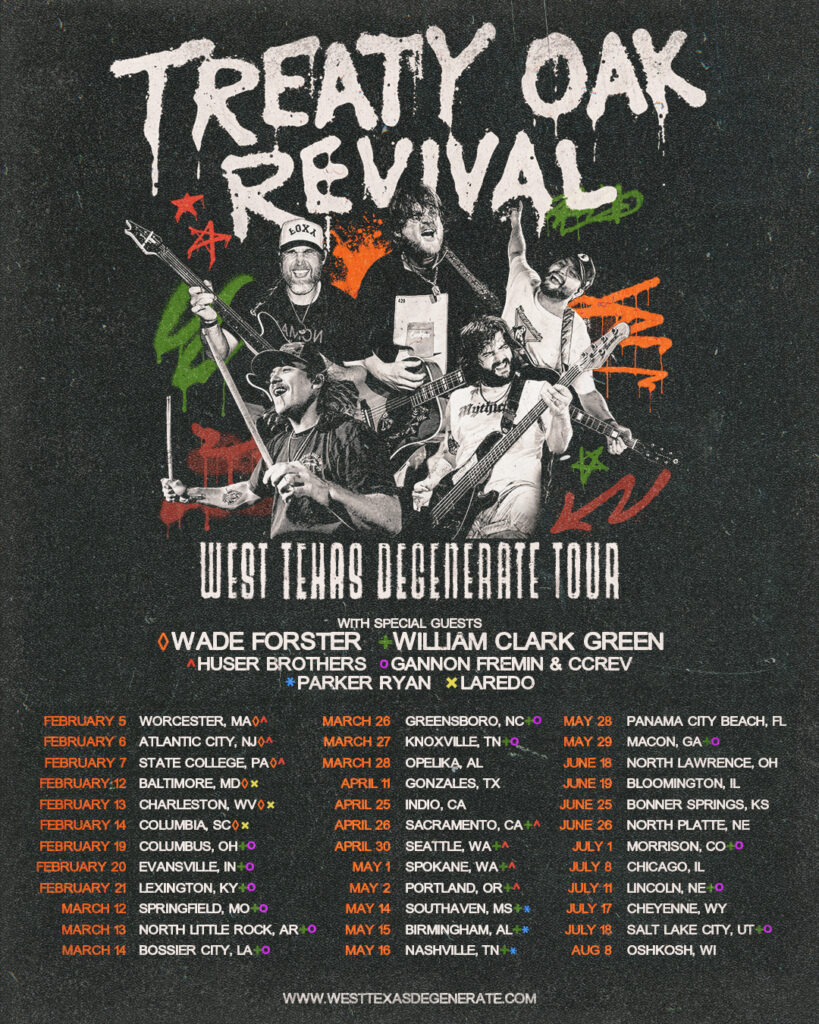
Sam Canty spoke with Buddy’s Ian Saint the week before West Texas Degenerate’s release. A transcript of their conversation, edited for length and clarity, is below their 2026 tour graphic.
IAN SAINT: Good day, Sam. Our mutual friend David Forsyth says “What’s up!” I learned y’all went to high school together. He’s currently recording with the Ottoman Turks.
SAM CANTY: Oh, hello! I love David. I haven’t seen David in a long time.
IAN SAINT: Congratulations on headlining the Red Bull Jukebox in Nashville. I saw in my publicist friend Quinn Kaemmer’s Instagram Stories that folks were crowd surfing, which I’ve never seen before at a country music showcase. Is that typical at your shows?
SAM CANTY: Yes, sir. It’s happened before and it’ll happen again. I thought [the festival] went as well as it could have ever gone, given the circumstances. It’s something that we’ve never done before — it was our first time performing kind of a scheduled or scripted show. We had a few hiccups; but I think everyone was really happy about how it turned out. We sold out the Brooklyn Bowl [Nashville venue last] year, and that was a fun time; but I think playing The Pinnacle was our biggest show so far — it was really cool to see that many people there for us.
[Shortly after our interview, it was announced that Treaty Oak Revival will headline Nashville’s Bridgestone Arena on May 16. Below is the graphic for their 2026 West Texas Degerate Tour.]
IAN SAINT: You recently toured in Australia for the first time. When I went to Australia, I was surprised by how much parts of it reminded me of the USA, despite the distance and different accents — especially the Outback, which reminds me so much of the Southwest US. What observations did you have while touring Australia’s east coast?
SAM CANTY: This is a weird combination, but [where we went] kind of felt like Texas mixed with L.A. — that’s two opposite ends of the spectrum, but for some reason, that’s how it felt to me. [laugh] Yeah, there were definitely moments where I was like, “Oh, this is kind of like back home.” But there were some other things where I’m like “Oh, this is way different than how it’s done in America” — like the food.
IAN SAINT: I think you’re spot on. [laugh] Congratulations on releasing your new album, West Texas Degenerate. Of course, our publication’s namesake — Buddy Holly — hails from West Texas. He’s from Lubbock, rather than Odessa… Is Lubbock close enough for Buddy Holly to be perceived by Odessans as a legend from your area? Is Buddy an influence on you?
SAM CANTY: Oh, 100%. Yeah, we view Lubbock like our second home. It’s only, like, an hour and a half away from where we’re from. Every time we go there, everybody always shows up and brings the energy and rowdiness that we expect from our audience in the show. I would definitely say he’s one of the West Texas legends we look up to. One of the founders of rock and roll, some might say.
IAN SAINT: It’s remarkable how young Buddy was when he died, only 22, when you consider how long his impact has been. I mean, The Hollies from Britain are Rock & Roll Hall of Famers named after him.
SAM CANTY: Yeah, he did a lot of good stuff for music in general; a lot of people look up to him. It’s unfortunate he died in a plane crash — that’s why I get scared of going on planes so much.
IAN: There was a very apparent sonic shift from No Vacancy to Have a Nice Day. I think the second album was heavier, whereas No Vacancy had more of a country sheen. Did you get sober in between those two records?
SAM CANTY: Yes, sir.
IAN SAINT: Do you feel your sobriety has played a role in that heavier sonic direction? Also, how would you differentiate West Texas Degenerate from the preceding Have a Nice Day?
SAM CANTY: I don’t know if sobriety really changed how we sound sonically. I think it definitely changed how I’ve been writing and what I write about.
But I think the change from No Vacancy to Have a Nice Day was when we were writing No Vacancy, we were barely two years into doing this thing. We had all these songs we’d play at local bars, and everybody would ask, “Where can we listen to your music?” And we didn’t have any music out. We produced it ourselves, recorded it mostly ourselves with the help of this guy named Zac Edwards in our hometown — he had a little living room studio. We were really just trying to find our sound, and figure out what direction we wanted to go.
A lot of us are really huge rockers, so we liked the songs like [title track] “No Vacancy” and “Ode to Bourbon” on the first record. We wanted to lean into that more — try to do clean Southern or country vocals with heavy rock guitars and heavy drums. When we did that, we found our niche style. That’s how Have a Nice Day came to be; I would say Have a Nice Day was us truly finding our sound and the music we wanted to make.
West Texas Degenerate, I feel it’s definitely a continuation of Have a Nice Day in the playing styles and song criteria. But I would say it definitely has some elements that harken back to that first record — because no matter how much we rock, I’m still a huge Texas country red dirt fan. A lot of that shined through on No Vacancy, and I think a lot of it shines through on West Texas Degenerate as well. I think my buddy [Treaty Oak Revival guitarist] Lance Vanley said it best when he said this record sounds the most like us out of everything we’ve ever done.
IAN SAINT: I love that you brought back the theatrical intro and outro tracks, as you’d done on No Vacancy, that are like something out of a movie. I got a big kick out of that.
SAM CANTY: Well, we were supposed to have an intro and outro on Have a Nice Day, but we were so excited to upload it [in a rush]. And when we uploaded it, we realized we didn’t have any skit intros and outros like we had in the last record. So for the third record, we were like, “We have to make sure that we have something fun at the beginning and the end of this record, like we did in the first one.” So yeah, once again, harkening back to the first record, we wanted to kind of throw some of those elements into this one.
IAN SAINT: Listening to “Naders,” I was really floored by how heavy the drumming is. Does Cody have a double kick on his kit?
SAM CANTY: Yes.
IAN SAINT: He joined the band after you did. So were you into metal before he joined, or was his drumming a new extension for your songwriting?
SAM CANTY: We were all into metal. When we started to make Have a Nice Day, we had a drummer named Caleb Jones who came in for [original drummer] Kelly McKay, and he definitely added some more dynamics to the drums in some songs. Then he quit and started focusing on his own solo stuff, so that’s when Cody joined.
Cody has played in metal bands and ‘90s country cover bands, so it’s the best of both worlds. His drumming really opens up the possibilities when creating a song — what it’s going to be or the mood. Like with “Naders,” that song is obviously about a tornado; we wanted the music to reflect a tornado touching down. “There’s a whirlwind of trouble and it’s making its way downtown” — when the tornado touches down is when that big heavy breakdown comes in. I told him I want it to sound like just chaos — double kick, blast beats… lean into that metal background of yours, and just let it rip. And he came up with what he came up with. Man, that was so awesome. Yeah, we’re lucky to have Cody; he’s a phenomenal drummer.
IAN SAINT: Yeah. I’m based in Deep Ellum, Texas — but I’m really a metalhead from Cleveland. When I heard that, I was like “ahhh!” I never saw that coming. So I say, “mission accomplished.”
SAM CANTY: With this new record, we wanted to incorporate sounds from music that we grew up listening to — especially through our 20s and coming into our 30s. So you’ve got elements of psychedelic rock, pop, punk, heavy metal, Texas country, maybe some funky kind of pop guitar as well — we really wanted to make a true blend of all those different genres into this record, and bake them in there.
IAN SAINT: Speaking of guitars, I was struck by how you guys have three six-string guitars. Of course, that reminds me of Lynyrd Skynyrd, a comparison which I know you guys hear often. But a key difference between you and Skynyrd is you’re always playing acoustic while the other two guitarists are playing electric — a configuration I haven’t seen a band employ consistently before. Is that a conscious creative decision for your niche sound?
SAM CANTY: Yeah, so the acoustic [selection] is just that’s the instrument I know the best. I’m not the greatest acoustic guitar player by any means. My forte is songwriting, but I like to have the acoustic in my hands because it gives me something to do while I’m up on stage. Obviously, those guys are way louder than anything I’m going to play, but I think it does at least add a bit of void filler into the song. There’s some songs that I think this [next] year, I’m going to go ahead and put the acoustic down and try to do the whole frontman thing with the microphone. I’ve been doing that in live shows on [Have a Nice Day track] “See You in Court.” So I think with this new record, with this next new show that we’re about to build, I’m going to start doing some frontman stuff — kind of like Ronnie, you know.
IAN SAINT: Ronnie James Dio? [Black Sabbath, Ritchie Blackmore’s Rainbow, Dio]
SAM CANTY: Oh, [Skynyrd frontman] Van Zant. [laugh]
IAN SAINT: Oh, okay! [laugh] Ronnie Van Zant. Since we’d been talking metal, Dio came to mind. Well, that’s two Ronnies who were great frontmen.
SAM CANTY: Yeah. [laugh] Exactly, either way.
IAN SAINT: Since you guys have a unique sound that fuses different styles, I was wondering, what are some influences on you as a singer and as a songwriter that people might find surprising?
SAM CANTY: Well, a lot of the music that I base myself off of is Texas country. A lot of my singing style influences that I draw from would be Willy Braun from Reckless Kelly, Evan Felker from Turnpike Troubadours [Editor’s note: TT are in Oklahoma], Clayton Landua from Six Market Blvd. And I kind of try to embody Tom DeLonge from Blink-182, especially in my stage presence; I don’t sound like him that much, but that’s kind of my personality — I try to be funny and goofy on stage.
As far as songwriters go, I guess you could say the same three guys; but I like guys like Ryan Bingham, Ian Noe, and Benjamin Tod from Lost Dog Street Band. Todd Snider, who just passed away. The Damn Quails. Especially the Drive-By Truckers, that’s one of my favorite bands of all time. I like the guys who can really tell a story in that three to four minute time period. If you can explain something very complicated in three minutes, that most people would take 10 minutes to explain, I think that shows how good of a songwriter you really are. There’s not much you can say with as little time as possible, you know?
IAN SAINT: Regarding real-life application of songwriting, I noticed that “Happy Face” was co-written by original Treaty Oak Revival bassist Andrew Carey, who departed the band last summer. Given the lyrics of that song being about parting ways with a special person in life, do you see metaphorical significance to “Happy Face” apparently being his compositional swan song?
SAM CANTY: Yeah, so we wrote “Happy Face” when we were in Gulf Shores, Alabama. I called my wife after I stepped out of a restaurant, came back in and started writing the first lines to that song. And then I wound up finishing it the night that we uploaded the new record. So at that point, I was like, “This can be a new starting point for the next [record].” But I really wanted to work on this song, because we had some downtime and we were staying at this big beach house, and we had our trailer full of instruments. So I was like, “Man, I wish we could pull out our instruments and work on this thing while it’s still fresh.” And Andrew was the only one who really wanted to sit down and work with me on it. [laugh] So he helped me out with a lot of the musical parts and a few of the lyrics — mainly just the change from “a hundred miles away” to “a thousand miles away.” Andrew put a lot of time into these bass parts on this new record, and I think he does see them as kind of his swan songs to Treaty Oak. He brought a lot of cool stuff to this new record, and we’re happy to keep him on it.
IAN SAINT: I’m glad you referenced your wife, because I love “Sunflower” — your ode to her. And I love the geology that you invoked in it, like the Okie winds. And, you know, it’s so fascinating to juxtapose that with the debauchery at the start of the album. “Sunflower,” as I understand it, is a very different exercise from what you’ve put out before. Was writing a tender love song a challenge?
SAM CANTY: It was a challenge; I’d never really written a love song before. I wrote it because my wife always told me when we were dating and engaged, “Man, you have all these songs about all these other girls who treated you terribly. But you don’t have one single song in there about me.” Well, all right. I wrote her a couple of love songs; but the night before we got married, I didn’t really have a gift for her. So I said, I’m going to write her that song that she wanted me to write about her. Sunflower is her favorite flower; it just came to me that night before we got married. I wrote it all down, recorded it on my iPhone, and sent it to her, and she loved it.
Yeah, that song is pretty special to me because I wrote that one just for her. Thankfully, she was nice enough to let me put it on the record — because I’m pretty sure that song is now going to go from being her song to being a lot of people’s song. So it was a challenge; but I guess when you’re in love, writing songs tends to come to you a lot quicker than you’d think. I was glad we had that; I think it’s a good palate cleanser to the record. It just goes to show that if you find your person, they’re going to love you, however bad or good you are — they’re going to love both parts of you. Yeah, I thought it was a good transition from heavy, really personal dark songs into kind of a lighter and happier side of the record — songs like “Happy Face” and “Blue Star” are more upbeat. And of course, the outro track, which is just a silly thing.
IAN SAINT: I was going to ask you about the “Outro,” because Radio Shack has hit hard times. Would you be willing to donate the “Outro” to be their new jingle? [It sings “I’m gonna smoke some crack at the Radio Shack.”] Because it’s pretty catchy.
SAM CANTY: Oh, I’d love to. [laugh] As long as we don’t get a cease and desist.
IAN SAINT: All three major record companies had labels courting you, which Billboard chronicled last year. After doing an Interscope Records distribution deal for a single and stripped-down re-recordings compilation, you ultimately decided to stay indie; and West Texas Degenerate is another self-release. Can you delve into why you made that decision? Because for a lot of people, the dream is to have interest from any record company — let alone, all three.
SAM CANTY: Right. Well, when we first started this, we had always been pretty anti-label — just because we’ve heard all the horror stories and seen all the movies, and we’ve even had friends who’ve experienced the bad side of that firsthand. So we’ve always kind of had a bad taste in our mouth when it came to record labels. We decided as a band that if we ever came to a place where we wanted to explore that, we would — and I think last year was that time. We wound up settling on one [label] that we thought had our best interests in mind, and really vibed with us.
But we operate as a band a lot differently than most. We have about 20 of our own employees that work for us now, and we’re kind of a family business — no one of us is really the big star, we treat our entire crew like we’re all stars and part of the band. And I guess the way we do things, at the end of the day, didn’t really match up with how these labels do things. We try to be as authentic as possible, whether in our shows or in our music or just how we act in general. I think we all came to the agreement that we were very glad to have had that experience with a label, and see how that works — we learned a lot from working with them, especially ways to help us operate as a band. But also, I think it showed us that we can do this just fine on our own.
IAN SAINT: It’s incredible to see you headlining arenas, especially so soon after you’ve played shows in the area — for example, you’re playing Dickies Arena in Fort Worth just 4 months after playing the Toyota Music Factory pavilion in Irving. Then you go on to play Houston’s NBA arena on New Year’s Eve. For those who went to the August show in Irving, will this be a much different show? And as a self-proclaimed “West Texas degenerate,” what’s it like to be playing arenas in Texas’ biggest cities?
SAM CANTY: What they can expect to be different is, we’re obviously going to have a new set list — we’re going to be playing a lot of the new songs from the record. And I wrote a lot of those songs to be arena rock songs, so I’m really excited to be playing those new songs at these iconic venues in our home state — and even the Paycom Center in Oklahoma, where the Thunder plays. I live in southwest Oklahoma right now, an hour and a half away from Oklahoma City, so that’s where I buy my hat.
It’s just amazing. We never in a million years thought that some guys from West Texas who started a band in a vacuum shop would ever be playing for this many people at these large sports arenas. It’s crazy. We’re blessed to be where we’re at, and grateful for the team that we have, because we wouldn’t be where we are without our people and without our fans. I’m really excited to play those shows and close out the year, and get ready and ramped up for the next one.
IAN SAINT: That’s a great way to round out your remarkable year. Thank you again for speaking with Buddy Magazine — it’s an independent publication of more than half a century. We’re delighted to see you stay indie and represent Texas music well, especially with our namesake being a fellow West Texan. So we’re very excited for the new album, and you playing these banner shows in our state.
SAM CANTY: Yes, sir. Likewise, man. I appreciate you taking the time, Ian; it’s been a pleasure.
For Treaty Oak Revival tour dates and tickets, visit their official website: https://treatyoakrevival.com/.


