


By Rob Garner
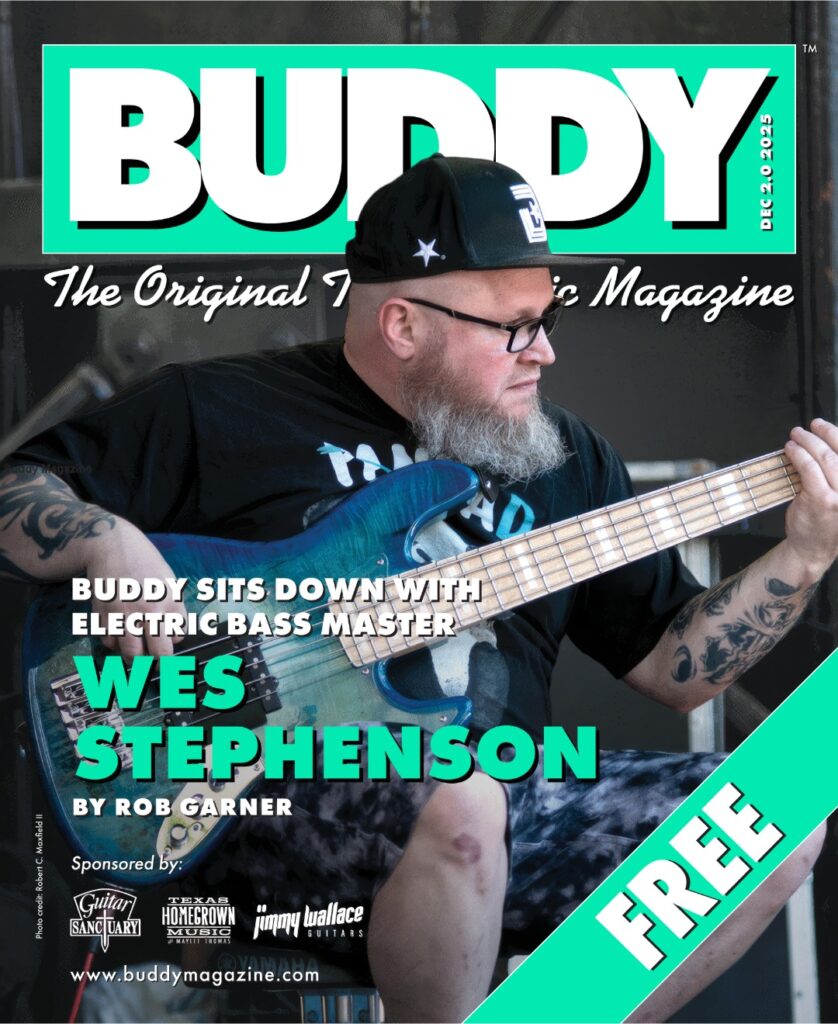
Cover photo by Robert C. Maxfield II
Photo by Matt Blum
If you ask the leading DFW musicians – and even music fans from Europe and around the world – who they think are the top Texas bassists, one name will almost always come up: 2022 Buddy Magazine Texas Tornado Bassist Wes Stephenson. Raised in North Garland, Stephenson’s path into music began after an injury ended his interest in playing school sports, and redirected his attention toward playing the bass. A friend’s performance of the Red Hot Chili Peppers’ version of “Higher Ground” convinced him he wanted to learn the instrument; soon after, his mother bought him a budget Memphis bass that became the foundation for his earliest studies. And that initial spark from the Memphis bass has evolved into a refined taste for boutique gear, which he discusses in detail in the interview that follows.
In addition to studying with several different DFW-area teachers, he taught himself by playing in church, and immersing himself in the amalgam of blues, gospel, funk, and jazz that has long defined the Dallas area. He briefly attended the UNT school of music, before leaving to go on the road with Tutu Jones.
Stephenson continued to shape his musical identity through constant live playing, mentorship, and the often free-nature of local jam sessions. His early experiences with Tutu Jones, Smokin’ Joe Kubek, and B’Nois King were formative in his internalization of the blues language and feel, groove, dynamics, and the value of emotional communication onstage.
Equally important were the musicians who pushed him conceptually. Keyboardist Bernard Wright (Miles Davis, Snarky Puppy) encouraged Stephenson to think of the bass as a percussion instrument. Bobby Sparks, with whom Stephenson worked frequently, further deepened his awareness of feel, articulation, and the creative bass language.
Stephenson later became a founding member of The Funky Knuckles, a group of players that grew organically from shared gigs, and grew to a formidable modern jazz ensemble with an international following. Through that group, and also his long-running work with guitarist Mark Lettieri, he developed a reputation as a bassist capable of exploratory grooves and genre-bending virtuoso musicianship. This adaptability has made him a first-call player across a number of genres.
Stephenson said that while touring in Europe with Lettieri and The Funky Knuckles, audiences and musicians abroad often revealed detailed knowledge of Dallas music and the circles he comes from. Yet his focus remains close to home: residencies, sessions, and community-based playing continue to ground his musical life. In the following discussion, Stephenson touches on many of these areas, and also talks about his gear, and how he views playing the electric bass.
Buddy Magazine: Let’s start with what are you doing right now. What’s burning project-wise for you?
Wes Stephenson: You know, mostly with Mark Lettieri. I enjoy almost every aspect of that band. The writing, the camaraderie. Everybody is super cool and we’re doing some pretty cool stuff next year. We had a really busy front part of the year and it’s kind of chilled out around this time. And then, the Funky Knuckles, but I don’t really know what’s really going on. We play around town a little bit, but we basically stopped touring.
Buddy Magazine: Why’d you stop touring?
Wes Stephenson: Well, man, it really sucked. Right at the time of the pandemic, we had just about reached the top of the hill, and we were starting to actually make money on the tours. The tours were playing good rooms. We had a good booking agent. And then the pandemic happened and some of the guys in the band were very cautious, a lot more cautious than I would have been personally. They didn’t want to get back out and all that kind of stuff. They were really worried about it, which I completely understand.
I think what happened is that we let too much time go by before we really started trying to get back out, and then we couldn’t. We haven’t found another booking agent. We still get calls from time to time. We’ve done some European things because Mark was very gracious and put us in contact with his booking guy in Europe. So we do go to Europe, but we’re not doing much in the States.
Buddy Magazine: You were playing big halls in Europe.
Wes Stephenson: It does really seem like the [European] countries put a lot more emphasis on art and culture. And so it’s like nothing to do a festival in a little bitty city and the whole city comes out. In Italy they have those big courtyard type things, and there will be 5,000 people there.
In the Netherlands, they have these really big concert halls with multiple rooms, and it’s fully catered. Doing a bus tour, there’s showers, there’s laundry. It seems to me that they put more emphasis because it costs so much money to get a band, especially the size of the Funky Knuckles. Well, it’s not that big of a band, but six people. And a tour manager. It costs a lot of money to get us over there. They have to make sure that we’re playing in good rooms so that they get their money back.
We just had the hardest time finding a decent booking agent. And we’re going to Canada, I can’t remember when. It might be the beginning of next year, but we’re going to Canada to do a festival, and it’s a pretty good paying gig. It’s really hard to do a van tour in the States. And especially in Texas because you’re so far away from any of the major markets. So getting there is expensive. And then you still have to drive for like 10 hours. If you go on the West coast and you drive, there’s nothing. Until, like, Phoenix. It’s hard to do that.
I hate to say it, these American clubs – sometimes they don’t care. At least in Dallas I can go home. So the Funky Knuckles kind of slowed down. We do every first Monday at the Balcony Club. And then we’ll play at Triumphs or sometimes Revenue.
Buddy Magazine: Now, are you playing with Junior (Mike Clark)?
Wes Stephenson: Yeah. Junior’s the best. I love that dude.
Buddy Magazine: He is for sure. Any plans for a new solo album?
Wes Stephenson: I’d really love to do that. The first one was only something I did during the pandemic. Just to be doing something productive. I was going to put it all in a Dropbox file, and put it out on the Internet for everybody to listen to. But a couple of my friends were like, ‘man, just put it out’. I’d like to do it again, but I would like to do it differently, because obviously that was all remote recording. I’d like to do it live, and really take some time on it and get it mixed the way I want.
Most of the people that I would want on it live here anyways. I also like the idea of doing a live recording.
Buddy Magazine: And you recorded that at home?
Wes Stephenson: Yeah.
Buddy Magazine: It sounded great.
Wes Stephenson: And warm. A lot of the guys that I had on it have pretty good setups. And then my buddy Bear mixed it. He’s done several Funky Knuckles records. And he’s a good guy. Got it right here.
Buddy Magazine: I was listening to “Buster” earlier. Tell me if I heard this right. It’s kind of like a displaced 16th note groove on top of 4/4.
Wes Stephenson: Yeah. TaRon Lockett recorded drums on it, and he said it was messing with us.
Buddy Magazine: That’s the thing about it. And even the keyboards are kind of floating over everything. It’s layered. That’s unique.
Wes Stephenson: That was Bobby Sparks.
Buddy Magazine: Oh, okay.
Wes Stephenson: “Buster”. Yeah. I waited, like, probably like six months for the files.
Buddy Magazine: Worth the wait.
Wes Stephenson: Yes, it was. And then he sent, like, 4 million files. Like all that string stuff was all single notes from an Arp. The first two tracks, if there was a solo thing happening, a POG and this kind of crazy distortion pedal. It’s more like a gated fuzz, you know?
Buddy Magazine: That describes it. So you don’t get too much into effects – you’re more direct-in?
Wes Stephenson: Well, I love effects. I have a love-hate relationship. I love them like in the studio, or if I’m recording, or if I could have them set up on a table right next to me. I play mostly active basses. And the trigger of the fret can be different if you attack the string harder, or less. In a big room, I’ll end up playing a little bit harder because I don’t hear myself as well. I have a hard time getting consistent sounds in different rooms.
I didn’t start playing with pedals until I played in a trio with Bernard Wright and John Carruth. And Bernard and John were both really trying to get me to use more effects. So I started then.
Buddy Magazine: So they were trying to get you to use more. Why was that?
Wes Stephenson: Just different sounds. You know what I’m saying? Just for different sounds. I had never played used effects up until that point. I’m not used to them. Good company with Bernard, of course.
Buddy Magazine: What was his view on bass that shaped you a lot, or that you took as a lesson?
Wes Stephenson: Yes, I learned a lot of things. The two main things that I’ve learned from Bernard – first of all, play like a drummer. He played the keyboard like it was a drum, especially when he’s playing rhythm, like comping. And in that sense, he’s probably one of the best drummers I’ve ever played with. His groove was so strong. So locked in. It was just ridiculous, man.
I started trying to think of my bass as more of a percussion instrument than the notes. You only have so many notes, but there’s endless rhythms and phrases that you can. There’s just so much more there that you have in your toolbox. And then the other thing he always talked about – he called it ‘birds and fishes’. He said when you look up in the sky and watch a flock of birds flying, they move with each other, and it causes these beautiful patterns and shapes and things. But there’s never a single bird, you know, but they still move together. You know, and the same thing with a school of fish.
He said, when we’re playing music, “I know it’s my band, but I don’t want you to not take a lead.” Or if I did, he was sensitive as a musician. If I did anything, he would even make my mess up sound good. But he wasn’t afraid to fall back and let the drummer play, or let the drummer dictate something. And it was like a very selfless type of playing. But then also trusting, building that trust and that kind of thing. He was really special at that. Yeah. I miss that guy.
As I’ve grown and tried to grow as a musician, rhythm and phrasing is everything. There’s this guy who plays on the Kill Tony podcast in Austin – they call him D Madness. But he’s an incredible drummer and he’s also an incredible bass player. Now he’s blind, so he can’t see. And I saw him come up here with Branen Temple. Like, great drummer. Has done a lot of things.
They came and played at this spot over by Fair Park and D came in and he was playing bass. They were playing really kind of complex, fusion type stuff. All he really played was pentatonic scales. But the way that his rhythm and his phrasing weaved through like these really crazy changes and like using five notes and it’s like, you know, like, man, that was, it was incredible to me, man.
Buddy Magazine: You seem to have gone back and forth pretty easily between the blues and jazz scenes. Not everybody does. You want to talk about that?
Wes Stephenson: Well, I’m a Christian and I play music in church and I felt God’s spirit move in the music. Not anything I was doing, but I felt it move. Matter of fact, we weren’t even doing much, you know. And when that happened, I could tell how it interacted with the congregation and it was absolutely incredible.
But I had a similar experience playing with Tutu [Jones]. You know, the way that he breaks the band down and is very dynamic, you know.
Buddy Magazine: He is.
Wes Stephenson: Just like I always said, man, that man Tutu can stand up in a chair in a room by himself with nobody and have everybody dancing. He’s one of the baddest. That really gave me a real deep respect and love for blues. And also B’nois King. I toured with Joe Kubek for a while.
B’Nois was such a wonderful guy, man. He really took me under his wing. And, you know, B’Nois is a phenomenal jazz guitar player as well.
—
Buddy Magazine: Who do you think are the best drummers in Dallas?
Wes Stephenson: Well, I always have to say, my buddy Cedric Moore. We’ve known each other for 22, 23 years. I’ve seen him grow into the drummer he is now. We’ve been playing together for so long – and more than three times this has happened – we won’t even be looking at each other, getting ready for a gig, just looking over, and I’ll play a note, and he’ll hit his kick drum at the same exact timing. If we fall into a group, it just happens. I call it rolling. When you’re improvising, I call it rolling dice. I don’t know what I’m about to play, but I’ll play something. And if it lands on something good, I’ll just keep doing it. Make sunshine out of rain.
Marcus Jones, and a young dude named Ad. He’s Marcus Robert’s son, and he just went to Booker T – I think he’s been out for a couple years now. But he’s killing. Cleon Edwards, of course, and Peabody. God, man, there’s so many incredible drummers. Then you got Andrew Griffin.
—
Buddy Magazine: Did you feel that electric bass wasn’t treated legit at university? How did that impact your college career?
Wes Stephenson: Well, I left – I only went there a year. I got that gig with Tutu. He was like, ‘you want to go on the road?’ I was like, yep, sure do. No one liked me at the school at the time. It’s funny, now, it would probably be a different thing. But yeah, at the time, they didn’t want to hear no electric bass. I don’t play double bass.
Buddy Magazine: Did you pick it up while you were there?
Wes Stephenson: I definitely had to play it. I did more bowing though. And it was horrible. You know, no one wanted to play with me. The only guys that wanted to play with me were the guys that were low on the totem pole. Even though I did the jazz combo classes. When I played in those [jazz combos], they seemed to like what I did. And I find it funny when – I forget if it was the Funky Knuckles or Mark – got nominated for Grammy considerations. North Texas put my picture up on their website. It was like “former UNT students”. I was like, man, you guys didn’t even like me when I was there.
Buddy Magazine: Now they’re claiming you. Maybe that’s eased up a bit.
Wes Stephenson: I don’t know about everywhere, but I know North Texas has. With all the modern jazz groups that have come through in the last 20 years. Which is about how long it’s been since I’ve been there. Well, longer than that. The electric bass is not a novelty instrument. And I’m sorry, the music that’s made on it is not novelty. And the technique that it takes and all that stuff. I think people are taking it more seriously now, even in the jazz idiom. But I will say I definitely prefer hearing double bass in a traditional setting. You know, me personally, I tried to say it didn’t bother me for a long time, but still doesn’t bother me. But I like upright better.
Buddy Magazine: Do you teach now?
Wes Stephenson: I am the world’s worst teacher. When people ask me, I tell them that first. And then I say, but if you want to come to my house and sit down with me, and we can play and talk about music, and I’ll probably drink a couple beers. You can have one, two even, you know, and if you don’t mind my bulldog, you know, my daughter and my wife and, you know, I’ll do that any day. Yeah, but taking money from somebody to, like, teach them, I don’t do that well.
Buddy Magazine: Who did you study with when you were coming up?
Wes Stephenson: I studied with Lou Harlas, Chris Clarke, and Rich Thomas. He had a very long standing jam session at O’Reilly’s way back in the day. With several different musicians. And Mike McCullough – he passed away a couple years ago. He’s a Texas Tornado..
Joe Lee [Richland guitar teacher] is one of my most favorite people ever. My experience there was like a lot of the people were just kind of unserious. But I was real serious. I constantly asked questions. I couldn’t read very well, I still can’t. But Joe had a reading class, and in that class it was just three of us. I started asking all these questions and the next semester he turned it into a jazz master class. The first time I ever improvised a solo worth anything was with him. Because I’m a conceptual person and not like a super detail oriented type person. Where Joe, I think is similar. A very philosophical way that he teaches – the way that he looks at guitar. I learned a lot from Joe, man. And I saw him not too long ago at a Mark [Lettieri] show. He and Junior are good friends. Richland was a great experience for me.
Buddy Magazine: What’s part of your story that you want people to know about?
Wes Stephenson: There’s so many great musicians here. I’ve been to a lot of places in the world, and everybody outside of America knows about Dallas, and a lot of them know more than I do. And I’m from here, going back to the 60s and stuff. All the people that have either been here and played, went to other places. Like, my man that played guitar with Donnie Hathaway, you know, he’s from Fort Worth. Cornell Dupree. Him and Chuck Rainey. Lucky Peterson. Erykah Badu. Roy Hargrove. Bobby Sparks.
JT. He’s an incredible drummer. You know, all the gospel stuff. I just did a session with Kirk [Franklin] for his upcoming record. Man, it was cool. It was really interesting seeing how they pieced together a song. But that was kind of a bucket list thing.
So much stuff happens, I don’t even think to talk about it. There’s so much history and music culture. Even contemporary. Just incredible musicians that live here and play here all the time. You know, you go see them at a club and there’s 20 people.
I wish the city had a better way of doing promotions for this stuff. I mean we used to have the Observer. To me it really [it changed] when Clear Channel bought up all the radio stations and all the billboards. When was that?
Buddy Magazine: I want to say late 90s.
Wes Stephenson: I think that really hurt our local scene. Because I came into the scene at the tail end of when we had local radio stations that promoted local events and stuff like that. That was always cool because you knew where shows were happening. Whereas now, the Internet and the social media stuff is so diluted.
I hear people [say], “Oh man, I wish I’d have known that was going on.” You know, and we all post about it. Xavier Lynn. He’s touring now with Mono Neon. Guitar player. But he just moved here from Atlanta and he’s going to be doing every Wednesday at the Free Man. People need to know about that because this dude is ridiculous on guitar.
Buddy Magazine: Are you also playing with Hedras?
Wes Stephenson: Yeah, yeah. Hedras too. Completely self taught guy.”
Buddy Magazine: He came from Guatemala? Do you know why he chose to move here – for the things you’re talking about?
Wes Stephenson: I think so. It’s why Xavier moved here because in the last 20 years, you had Snarky Puppy. First of all, you had the RH factor – Roy Hargrove – which in this first iteration was Bobby Keith, and Jason JT Thomas,. You had that group, you had Erykah Badu, you had Snarky Puppy.
Then you had Funky Knuckles and Mark and everything. There’s something in the water here, man. I don’t know what Bobby and them would say. For me, those guys were the archetype because I tell people to this very day, if I had to pick three of my favorite bass players, Bobby Sparks is really one of them because the way he plays key bass is just ridiculous. His feel, everything. They played there all the time, at least twice a month, man. And it would be Bobby, JT, Bernard Wright, Keith Anderson, Todd Parsnow.
And they were just playing standards, but they was funking on them. Sometimes they swing, you know, but they was funking on them. And then playing with ‘Nard [Bernard Wright] for as long as I did, I can take good, complex changes and play a groove on it instead of swinging it. Everywhere I go in the world, man, people talk about Dallas. And it’s bringing a lot of musicians here because they kind of want to get in that suite
RG: Another topic, how did the Pandemic change you creatively?
Wes Stephenson: I definitely know I started doing a lot more session work. People would ask me to play on the records, which was very nice because I had very little income coming in. I loved and hated the Pandemic. I had a tour I was going to do with Larry Carlton. His son Travis, who plays bass with him, is a pretty good friend of mine. And we’re very similar in our playing. The way he loves blues and old school, and then is a great improviser and likes the new school too.
We were on a tour with Mark and he was in this other band. We hit it off just like that, you know? I was going to do that tour with Larry Carlton – we were going to play the Montreal Jazz Festival. Or North Sea Jazz Festival, I can’t remember. But it was like, all this stuff that I was gonna do. And it all got shut down. But I had two and a half years straight with just me and my child every day, and that was awesome. It grounds you. When she was born, I started traveling more than I ever had, so it was cool to have that time, to really get our bond together.
Buddy Magazine: Good for you, man.
Wes Stephenson: Proud husband. My wife’s badass.
Buddy Magazine: Congratulations on your happy family. It’s a beautiful thing.

—
Buddy Magazine: What kind of basses are you using?
Wes Stephenson: Callowhill – the luthier’s name is Tim Cloonen. It’s his version of the Jazz Bass. Then I’ve got that Steve Bailey six jazz that they made for like a year. I would tune it F sharp to G instead of B to C. It’s a bad bass. I love that bass. Best B string on any bass I’ve ever had. I have a ‘97 or ‘98 Fender Jazz. The Suhr-era jazz bass. Then I have the first Ultra series Fender Jazz. I got an F Bass. It’s basically just a jazz bass. My favorite bass is a Performance jazz bass. This guy from California, Asian fella, Yaz. And it’s my favorite jazz bass I’ve ever had.
And then I’ve got two Bass Mods which are actually really nice. A lot of the gospel guys started playing them because they were cheap. They were like under a thousand for a long time. Kind of like the Sire. But they were really great instruments. And it’s the only two basses I’ve ever got out of the box that felt that were almost perfect, that I didn’t need to do anything to. They cost more now, but really good basses, man. Work horses.
Buddy Magazine: Do you use all round wounds? Any flats on any of your instruments?
Wes Stephenson: That’s the only bass I have with flats. That’s not really my sound, but it’s cool. I would do a session and somebody would want me to have a P bass. So I’d either have to borrow one or something like that. I was like, man, screw it. I’m gonna get it. Then I’ve got a four-string too. Just a Mexi P-bass that sounds really great. And then a double bass. I think that’s it.
And then I’ve got a five-string, Fender P. The B string on it is about that big round – it’s like the old Jamerson [sound], you know. On Mark’s last record, I use that on some of the songs. Sounds great.
Buddy Magazine: What kind of amps are you using?
Wes Stephenson: GK. I love the Legacy 800, I love that thing, man. Sounds great. I can put it in my backpack when we go overseas. It flips over to their power. And it’s consistent.
I’ve got two Schroeder cabs. This guy from California makes pretty solid cabs. I have an 800 watt 4 ohm 112, and that booger, you know, like it’s hit. Then I’ve got a 212 biome and that thing, it’s almost too loud. But on the road with Mark, and I would have never thought this, but that GK with the amped SBT410, it sounds great. It gives me all the snap and it’s got good bottom end. It’s a little scooped, but with my preamp, I use Johnny’s preamps in all my basses. I can dial back in some of the mids, the low mids. It’s a great combination.
—


