


By Andrew Daly
Photos by Chuck Flores
Born and raised in Dallas, Texas, at a time when the vaunted Vaughan brothers reigned supreme, it would have been all too easy for Jim Suhler to get caught in the supposed “Vaughan way” of doing things.
But Suhler didn’t do that. And to be fair, he also came up around the same time as Rocky Athas, Eric Johnson, and others, meaning despite the emphasis on all-things Vaughan as it relates to Texas guitar slinging, there was a whole lot more to the proverbial peeling of the six-stringed onion.
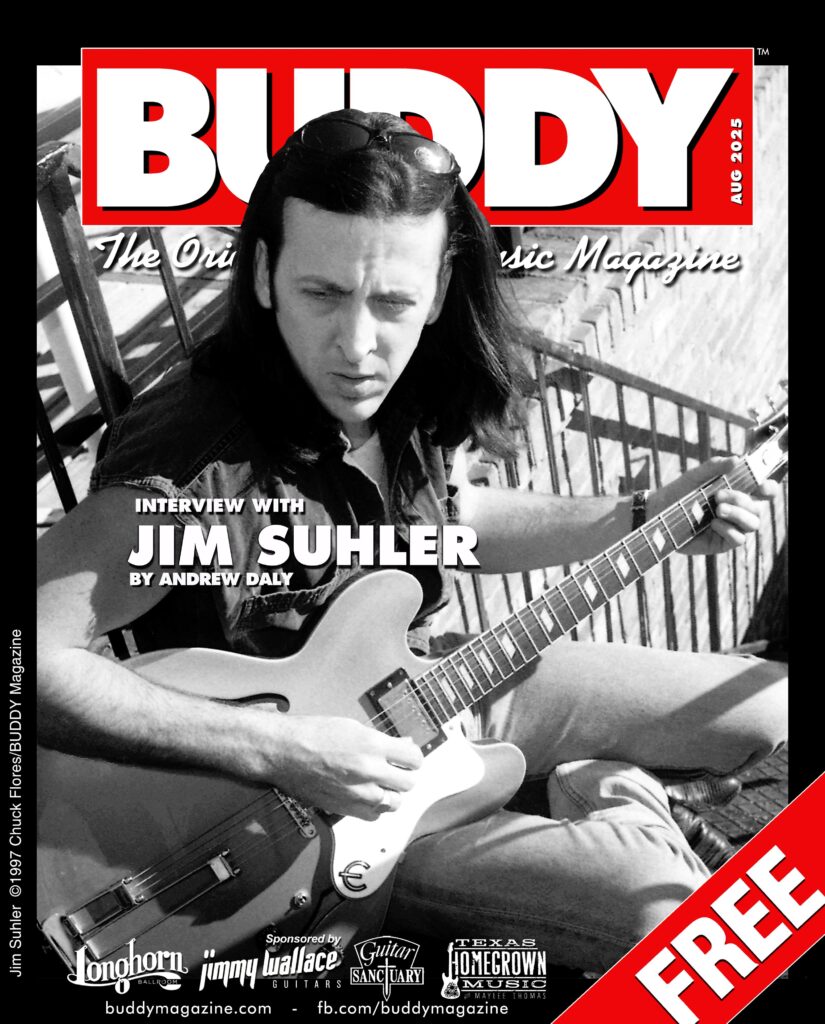
To that end, meaning the guitar and a life in music, Suhler never really had a choice—he was meant for it. “It chose me,” Suhler tells Buddy Magazine. “I think most musicians would agree.”
Still, it took a beat for Suhler’s talents to be properly exposed to the world. Sure, there was and is Monkey Beat, Suhler’s bluesier-than-bluesy rock band with which he’s dropped over a dozen albums since 1993. But it wasn’t until Suhler hooked up with George Thorogood and joined the Destroyers on guitar in 1999 that things truly kicked into overdrive.
Since then, Suhler has toured the world with Thorogood, sharing the stage uwith AC/DC, Billy Gibbons, Joe Bonamassa, Johnny Winter, Buddy Guy, Elvin Bishop, and more. When he looks back on it all, he’s nothing short of prideful for what he’s accomplished, especially given Texas’s storied guitar history.
As for what makes Texas such fertile ground for guitar players, Suhler laughs, saying, “Wide open spaces and big empty places! I think there’s a certain swagger that goes with it. The guitar gets featured front and center a lot, so the focus is on that. Maybe it’s the water, or the barbecue. [Laughs]”
What inspired you to pick up the guitar?
Initially, it was The Beatles and all the stuff I heard on the radio on KLIF 1190, which was a big top 40 station at that time. I thought that it looked like a pretty cool thing to do, but it wasn’t till later when I began going to concerts in the early-to-mid-70s that I realized there was a viable path in it for me. It was also a sense of identity for me at that time in my early mid-teen years.
Can you remember your first guitar?
My first guitar was a Yamaha gut-string. I took lessons from a college student at SMU for about six months. After that, I was sort of left on my own devices, picking out things off records, learning things from other musicians my age and watching bands live.
What was the Dallas, Texas scene like around you growing up?
There was a great club here in Dallas at that time called Mother Blues. Freddie King played there all the time, and any touring rock band worth their salt made a pilgrimage there. Freddie King, Bugs Henderson, Jimmy and Stevie Ray Vaughan, Rocky Athas, Dimebag Darrell, and more than I can list here were playing locally then. And I was always trying to check out as much of it as I could at an early age.
You never shared the stage with Stevie, but you met him, right?
I saw him play a lot back in the 1980s, and I finally met him in the summer of 1989. My dad owned a jewelry store in East Dallas, and one day I was visiting the store and as I walked out, Stevie Ray Vaughan was walking in to get his watch repaired.
Did you get to talk with him much?
We ended up chatting, and he was really friendly and told me to keep it clean. He was in [addiction] recovery at that point, then I guess he knew I needed that advice. Later, he played two months before his death at Starplex in Dallas, and I went to the show and brought him his watch back. He had been on tour and never picked it up. All of us here in Dallas were very proud of him and loved him a lot.
What was your rig like in your early days?
Back in the ‘70s, I used a Peavey Mace, Sunn Concert Lead, various Marshall heads, before settling on Fender amps in the mid-80s.
In the ‘90s, you joined George Thorogood’s band. Was there an audition?
I had a band in Dallas at that time, and we would tour originally, going to places like Houston, Jackson, Mississippi, Little Rock, and in this case, Memphis. We were playing at Huey’s Midtown on Madison, and George and the band came in following a day’s recording at Ardent Studios. George liked what we did, and we talked. He told me his producer, Terry Manning, would love us. After a few months, I had a new band together, and we were going to make an album, so I remembered what George said about Terry Manning and reached out to him in Memphis.
To my surprise, he agreed to do the project. We ended up making several albums with Terry and his label Lucky Seven, and that led to me touring as an opening act for The Destroyers and later joining them as second guitarist in 1999.
What was it like playing two shows as openers with AC/DC in 2002, and how did that happen?
I was touring Europe with George Thorogood & The Destroyers, and we ended up on two dates with AC/DC, one in Helsinki and another in Hamburg. They were beyond gracious to us, and they were wonderful hosts. Really friendly guys, and it was a dream come true for me. It was the Stiff Upper Lip tour; I’m a fan for life.
What’s the key to locking in like Malcolm Young?
He was brilliant, the subtle rhythmic shifts he would use within one song. Very crafty and under the radar, but that’s part of what makes what they do so special and enduring. He knew how to use space, and the band always had that swing. His right hand is unmatched.
While with George, you’ve kept your band Monkey Beat going. Why is that outlet important to you?
I just enjoy having a lot of irons in the fire. I like to stay busy, and I still enjoy it. It allows me to explore different avenues of expression, and as long as it’s fun, I’ll continue doing it.
What are your favorite songs to play with George, and are those songs more challenging on guitar than people think?
I love playing the rhythm parts and working in the engine room. Having said that, I play a Drop D rhythm part on “Madison Blues,” which I enjoy. I really like some of the early stuff, like “Ride On,” “Josephine,” and “Bottom of the Sea.” The challenging part is finding the right thing to play. And playing it consistently.
What can you say about George as a player and songwriter?
George came up digging John Hammond, Hound Dog Taylor, Chuck Berry, and Bo Diddley; that was his template. He’s stayed true to that vision, and songwriting reflects that. I’ve learned a lot from George over the years. He’s also a great entertainer, and that needs to be said. His ability to connect with an audience is remarkable.
What’s your staple rig, and how has it evolved over the years?
With Monkey Beat, I use either a Fender Deluxe Reverb 1×12 or a Fender Vibro-King 3×10 coupled with an Ampeg Jet 2 reissue with 1×12 inch speaker. I’m trying to keep things manageable, but I love Marshalls and that classic sound. But I’ve always had better luck sonically with Fender amps.
Do you have a secret weapon in terms of tone? Is it hard not to get caught up in the FOMO of effects pedals?
I use an Archer Ikon boost/overdrive with the Destroyers. I also use a Boss Tremolo pedal on occasion. My pedal usage with the Destroyers is minimal. But my Monkey Beat pedalboard includes a Polytune Chromatic Tuner, Big Joe Distortion Stomp Box, Ibanez TS808 Tube Screamer, TC Electronic Shaker, and a Boss DD-7 Digital Delay.
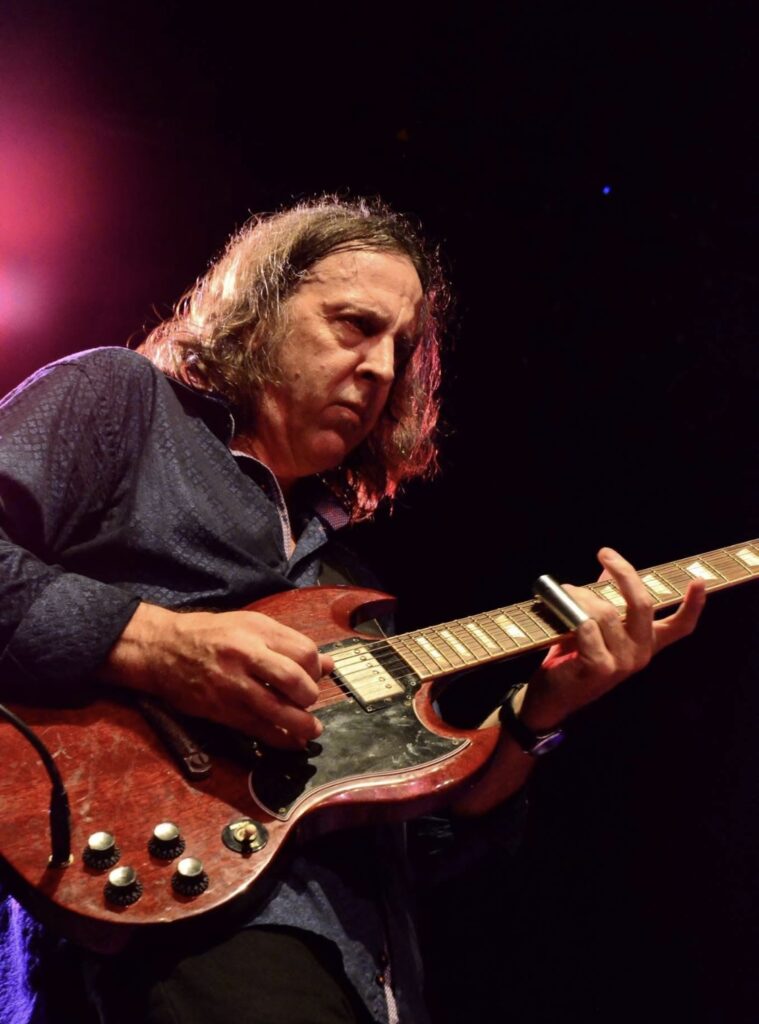
Are there any techniques that have been the hardest to master? If so, how did you get them down?
Any thumb-picking style, such as Mississippi John Hurt or Blind Blake. It’s a vast overstatement to say I’ve gotten it down. I love doing it when I’m sitting around the house.
If you could scrap who you are as a player today, and build yourself as a model, imagine in your head, would you do it?
No, those flaws keep it interesting. I like being surprised.
Where do you go from here, and how do you plan to progress as a player?
I want to continue to write songs and work with talented and gifted people, that’s always been my ongoing mission. Just trying to find the right parts to play, tell my story, and make it sound good.
—


