


By Don Ward
As many musicians and music fans slowly have slipped back into “normalcy” in the last couple of years since the pandemic was over, some captivating stories have emerged, revealing the extent of effort – and need – for some artists to both create and perform. Even when the whole musical world they had previously known had shut down, these players did everything they could to keep making music, and keep being creative.
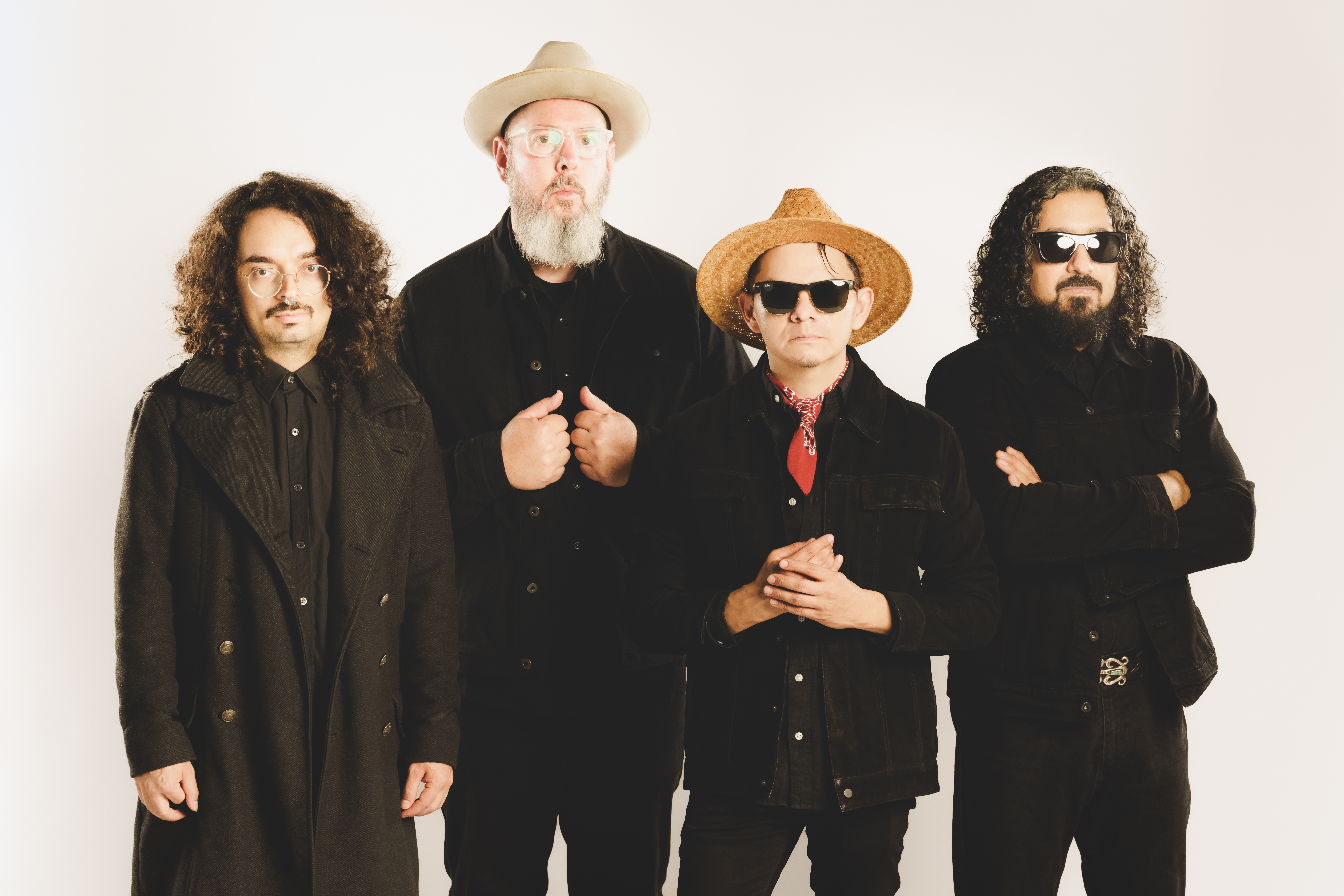
One such story is that of the founding members of Austin’s Grammy award winning latin rock band Grupo Fantasma, and their latest band creation, Caramelo Haze. While the group has had many offshoot acts such as Brown Sabbath, Dos Santos, and MoneyChicha, this new act emerged from the screeching halt of an unplanned world shutdown.
While live performance of music was almost wholly non-existent in Texas in Spring of 2020 (except for The Free Man venue in Dallas), musicians Alex Chavez, Beto Martinez, John Speice, and Victor Cruz continued to make music, not knowing where it would take them. And by the end of it, they realized that they had an entirely new band – one that would get signed to Nacional Records, and also take the band on some high profile gigs, like their October 2023 appearance at the ACL festival in Austin.

Buddy Magazine sat down with Caramelo Haze after their performance at ACL last October for a chat. In only a few minutes, it was easy to tell that these tight-knit guys had seen a lot of things after playing for over 20 years together. What also stood out was that these extremely talented musicians are not successful by accident – clearly, they have been prolific in their musical output, diligent in searching for opportunity, and hardworking in their craft. And they absolutely do not shy away from business talk or creative inspiration, and it clearly comes out in this free-flowing discussion.
Don Ward (Buddy Magazine): Can you talk about the original resilience you had with just keeping the group together over the last few years?
Beto: Sure. We formed in 2000, but I’ve been a working musician since the mid-nineties. John, too goes back, and Alex was playing in bands here in Austin as well in those early 2000s. And this particular band, Caramelo Haze, we put it together over the summer of 2020 in the middle of the pandemic. So that was definitely a challenge, but that’s when we first got together and started writing and recording. And definitely having that sort of longevity in this business can be rare. What has allowed us to do that has been, first of all, the personal relationships that we’ve kept. So it’s been a pretty tight core of people. There have been people that have come and gone, some people newer than others, but I think working with people that we trust and we’ve known for a long time, but also being, I think, determined that not we at some point made a decision that this is what we were doing.
We weren’t doing it on the side, we weren’t doing it on the weekend. We were like, this is what we do. So we look at it on the long-term because there’s a lot of ups in there in this business. We’ve had some great moments, super high moments. One that comes to mind in particular is playing with Prince and touring with Prince and doing stuff like that that was at the top of this game. And then shortly after that, you have a gig at a bowling alley or whatever, and no one shows up and the promoter doesn’t want to see you. So there’s that dichotomy that exists in this business, and you kind of have to prepare for that through the good times. You have to be ready for the means. I mean, so I think we’ve gotten good at that because a lot of ups and downs, and that’s really what’s given us that longevity, I think.
Don Ward (Buddy Magazine):Yeah. And as far as the grit that it takes, it sounds like based off of what you just said, you’ve gone through these challenges, there’s a resurgence going on. What’s your overall vision of where you want things to go on the business side?
John: The business itself is based largely around access, and it’s not easy to get access. And what I mean by that is access to opportunities, access to bookings. As Fantasma as a collective, because we have Brownout, we have a bunch of bands. That’s also one of the keys to being staying together is having a diverse bunch of projects you can do. So that one thing doesn’t just burn you out. But it’s difficult to strategize access, you know what I mean? It’s kind of like a luck and timing thing as well as just continually putting balls in the hopper and writing for each of these projects and then hoping that you hit the right person’s ear, and that they decide that they want to from their end, from the production, from the other end of it. Artistically put energy towards it. And that’s another thing that ebbs and flows as well as the creativity is just your ability to get access. That’s why people age out of the business.
So our strategy is to make good music always. And then we are also constantly trying to make relationships based on past successes. And also just the promise of we can take this to the people for the future, to get some things going in the future.
But that’s as a studio owner and a producer, and Alex is a professor at Notre Dame. We all are all family people, and we have many irons in the fire from a business point of view to just get by. And we’re extremely lucky that we had some success in the early two thousands. That kind of has grandfathered us into some opportunities that maybe some people don’t always get. The flip side of that is you’re only really young once. [Laughter]
Beto: There’s a lot of experience that we’ve attained and we know now that not to chase that stuff. So we’re working to build good relationships with labels and publishing companies and stuff that can make you, that can generate revenue down the line once you get older and once you’re not on the stage anymore. So that’s really important to us, and that’s something about building our catalog,
Having a lot of music out there, and getting it in the right places and making those relationships. Like Alex, for example, the trustee with the recording Academy with the Grammys, and that’s a lot about networking and making those particular relationships. We played in the BMI stage where there’s a lot of people there that we’ve got to meet, and hopefully work with in the future that can help us get those sorts of placements and things like that, where you can generate that revenue into the future even once you’re little too old to shake.
Don Ward (Buddy Magazine): As far as being in Austin and having your roots here, how do you think that’s really translated in a positive, or negative way for your careers?
Beto: I always tell people that Austin also is very important to our musical career because when we started here, it was a very different place. It was a very easy lifestyle. It used to be cheap to live here. So when we were in college and had just moved here in the mid-nineties, it was very cheap. We could get a house, the whole band lived in a house and the whole rent was $550 a month. So we could work some stupid job that we didn’t really care about and spend most of our time playing music and building that side of it up. So for me, that’s what I think was so important about being here in Austin, because it was a very cool and laid back place and cheap for musicians, that’s changed a lot. And I feel lucky that we got here a long time ago and sort of built our networks and set everything up at this point, because I see young people that are trying to do this, and it’s a lot harder. I’m like, how are they doing this money to do it? It’s like crazy. So I’m like, you still come here?
John: It’s a beacon, a live music capital of the world, but it’s hard for me to imagine coming here right now and starting. We did in the nineties, we were close to the ground and all the artists lived in 78704, and all the rest were cheap. And so it’s still going on with the young people that just quadruple the price, the cost of living.
Buddy Magazine: A lot of great art movements have happened in situations like that where everything’s affordable, the people are right there, and all the things that are cooking, like the Austin blues and progressive country scenes of the 70s. Then you have this economic shift, then rent goes up and the original scene kind of splits and it becomes commercial. Do you think that kind of creativity is still happening in Austin?
Beto: There’s good young bands, there’s really good young bands, great musicians. It’s a different ethos. I feel like a lot of the younger groups come in right away business-minded, and we weren’t necessarily business-minded when we started. We were like, let’s have fun.
And then it took us a while to realize, hey, this is the business. We need to get stuff in order to be able to do this, and we want keep doing it. The younger people are coming at it with that mindset already. So maybe that helps. And I would be foolish to say that ‘no, there’s not creativity happening here,’ just because I’m not aware of it. But I know that it’s there. So yes, I do feel like it’s still happening. It’s just different.
John: Yeah, 78704 has now moved out to Buda and Kyle. That’s where I learned studio, where his studio is. And so we’ve been pushed out of those zones that used to be so easy to be in. But yeah, creativity and the draw of this place and the support that the community infrastructure gives to music in the form of grants and things like that. We’ve used that to bring Peruvian masters here to play, and to learn from them. And so it’s about learning how to work the machine, today. But then, the kids are quick and this whole thing has developed where it almost doesn’t matter where you’re, because it’s based upon virality. It’s based upon TikTok and YouTube, and just creating every little moment in your everyday life even as content. And then I think through that, you grow this ability to be filmed and to have it not change. And I think that that’s transferred over visually as well. Everyone wants to have a little bit of information in a short period of time. And the kids are super good at it. Funny for us, people way younger than us, and they’ll be like, you guys, you got to get on TikTok.
Buddy Magazine : You mentioned that Alex is a professor at Notre Dame. Alex, what do you teach?
Alex: Anthropology and music. I’m from Texas and I came up in the same scene early 2000. In 2010 and 2011, I went up to the Chicago area. I’ve been up there since.
Don Ward (Buddy Magazine): How did that whole creative process go with you?
Alex: It was simple that nobody was doing anything during lockdown. You couldn’t tour or do live shows. There was nothing happening. Beto has a studio, and I had worked with him in a band that I played in Chicago, with Dos Santos, that’s my main project based out of Chicago. We had worked with Beto in his studio here. We toured together as Money Chicha, Los Santos. Long story short, we’ve known each other for a long time. Play music together on stage. They work in the studio, et cetera. Lockdown happens. We can’t do any of that. So I recall Beto putting up these short videos in his studio [on social media] where he was like, “oh, I’m going to challenge myself to write and record, and produce a song in two hours.”
And so he was doing this himself, and it was great. I was like, this sounds great. And we had worked together before and other shit, whatever. But then I remember reaching out to the dude, that’s great stuff, whatever. Then it dawned on me again. I was like, “Hey, man, you just doing stuff in the studio? Nobody’s working right there in the studio, right?” He’s like, “no, there’s no work right now.” Imagine, there’s no vaccine, there’s no nothing. The [studio is the] last place you want to be.
So it’s like, well, we know each other, we trust each other, whatever. I was like, “Hey man, you want to get back into the studio?” I was like, just to create in the spirit of that, not even talk about what we’re going to do. Not even write anything, just go to the studio and just create. And he’s like, “yeah, let’s do it. I’m not doing anything else.” And so I drove down from Chicago. No plane. I was not getting on a plane, no. Drove down and he had hit up Speice. And also Victor [bassist]. It was us four. And we got together two times that summer just to make music. We didn’t know what it was going to be. Just to create. And by the end of it, we’re like, ‘oh, this is a record.’ So I guess we made a record. And in a band. And we’re like, okay, well then, and that’s what it was.
And it was really in the spirit of being creative, and not having a lot of options at that point. And so we just, well, let’s just do this. And it was a beautiful experience, beautiful process. And we had this thing, this records beautiful record that we’re like, okay, well let’s pitch it. Let’s see what we want to do with it. And years ago, we would pitch to labels the things that were precious to us, our real, real bands. And one of the labels that we pitched to repeatedly was Nacional, which is the label that we’re on, which is the marquee Latin alternative label in the world. And so we’re like, screw it, let’s pitch it to them. And of course they’re like, “yeah, we want to put that out.”
So these things that were our babies, like Grupo Fantasma, or Brownout, here are these labels that would our ideal labels potentially we want to put something out on. They were uninterested. They were like, they passed this thing that was a total lark, that was in the sense of adventure and necessity.
And we (Caramelo Haze) were just like, well, let’s just do it and pitch it. Of course, that’s the thing that all of a sudden gets the traction and that we’re here playing ACL. We’ve only played a handful of gigs. We’ve played under 15 shows.
But it’s a testament to the work and the commitment and the fact that we’ve been around, we’ve done this, and so we want to be specific about something, we’re going to do it. And here we are talking
Don Ward (Buddy Magazine): You guys have been at it for a long time. On the entrepreneur side, I remember how scared I was during Covid. I’m a startup. I’m trying to survive, I’m trying to build. And then there’s something in you that really dig deeper for me. And going back to Alex’s comment, there’s some DNA here that I just want you guys to talk about. How do you stay creative? And this is all in the business side. How do you stay creative in the midst of chaos? You could have been like, “I have no creative juices left to work with.”
Beto: Well, to be honest, that’s what happened first because it was a shock. We released a record with our band Brownout on the day that they canceled South by Southwest. We were on stage doing soundcheck, and we got [a message on] our phones they canceled Southby. Then they started canceling the NBA and all this stuff. And then we had a tour, and sure enough that week our agent starts calling us and they’re like, dude, they this canceled, this canceled, this canceled. By the end of that week, the calendar was done and it was like, dude, I don’t know, man, I hope everybody’s safe and at home and was chill. See what happens.
Alex: Like a blackout.
Beto: And there was nothing from one day to the next, it was all gone. And this record that we had just spent a bunch of time working on and that we were so happy to put out there, it basically just went away. It just disappeared because no one’s like, ‘cool, let’s get you out for the record.’ It’s like, ‘what the hell is happening?’
So yeah man, for that first while, while it was shocking and depressing and I didn’t want to make any music, I didn’t want to create, and it was more about figuring out what the hell are we going to do.
And I had to kind of navigate some avenues of relief. You know what I mean? There was unemployment, and ‘can we get this grant? Can we get that grant? Could we work and see if they can help us out with this?’ And there were a few different organizations that were able to help us out. And I think everybody kind of focused on that personally. Once we sort of figured out, okay, we’re going to be all right, moneywise, we can weather this for a little bit. Then I got back into a creative mode. Then I was sitting at home. Yeah, my family, we started watching The Walking Dead. [laughter] That became just every day watching five, six episodes. You know what I mean? But after doing that for a little bit and just sitting around, I was like, man, I started seeing people getting online, getting on social media and doing live shows, you know what I mean? Just from their home.
And it just occurred to me, I have a studio, man, I can go in there and make some music right now if I wanted to. I don’t have my band, but it gave me an idea. And that’s what he was talking about where I was like, what if I played everything? So I sat down and started playing drums, which I’m not a drummer. I would never call myself a drummer, but I can keep a beat. And I had the time and space there to do it. So I started recording stuff and then I stumbled on this idea, or I gave myself an exercise. I was like, just write a song every day and record it and do all of it from start to finish, record it and mix it, finish it, and then put it online. So yeah, that’s the way you know that it’s done. So you have to turn your work in.
Alex: Yeah, and that’s the thing, when I saw that, it was the spirit of just going into the studio and just blank slate, just working. See what happens. A lot of times how we work, I feel like you record stuff, road testing or things that are already written and you document them and that’s great and you can experiment. But to go into the studio and be like, I have nothing. What do you have? Nothing. I don’t know. Well, let’s just go in here and just figure it out. And then that’s a very different process. But it’s also because we were so open to, I think on the one hand, being creative because there was no, to your point, how could you feel creative in a moment that was so much despair? Well, as a creative person, you couldn’t play live, you couldn’t, couldn’t tour. So all your outlets are gone. So it is going to be bottled up.
So what do you do? It’s like, well go in the studio and see what happens, right? And so we did it. So on the one level, there was that creative outlet. Two is just being willing, because of Covid, and in some ways a lack of a time constraint. The ability and the acceptance of like, well, we are just going to experiment because we’re not on a clock here. It’s like, well, we don’t even know what we’re doing, so let’s just do it and have that freedom
Don Ward (Buddy Magazine): So Beto, you kind of started the charge. Everybody came in and collaborated from there. Once you kind of got the creative spirit back, and then you guys are here now. You guys did at some recent sets in South by Southwest then, right?
John: Well, yeah. We went out to California in June, and we played out there Chicago. We played in Chicago most recently and then this, and we’re working on new music right now. We have most of a new record already started.
Don Ward (Buddy Magazine): What’s next for you guys? Who are you from the new music perspective, the messaging, just give the final thoughts on where you guys are going and so we can make sure we can capture that. Capture the essence of what you guys have done.
John: We did perform a song today that no one’s heard a brand new one that we really just are still finishing writing. We’re trying to, I think one thing that kind of didn’t get brought up is when you have personal relationships in long-term bands, sometimes the machine is creaky and hard to get rolling. And the way that this formed with four dudes surprising themselves, we had one idea, and then two days later, we had really most of a record without ever putting any thought into it. And so we’ve really tried to kind of maintain this new latest record that we are trying to do, new record, same thing.
We just got in a room and it’s like, ‘Hey, here’s an idea, here’s an idea, here’s an idea’. And luckily, thankfully, that creative trust that we’ve developed started to just form new other good music.
And there’s a lot of letting go when it comes down to it. You can’t control everything, but you can’t control if you enjoy what you’re doing. And if you truly have a place for it and enjoy it and it’s unforced, it doesn’t have a lot of baggage, then cool things can happen quickly. And that’s been our story thus far, is we’ve had some really good opportunities quickly. But mostly I think it’s due to the fact that we didn’t just say, “Hey, we are a band. We’re going to write a record.” We just got together with some ideas and went, “oh look, the band.” It happened really organically. And so we’re kind of trying to try-not-try, we’re trying to hold onto that without holding it.
But ultimately, I think in that regard, artistically, Beto and I had four bands for 20 years. Beto and I have known each other for 20 years. We’ve all been doing. And so I think we realized something. I mean, that period of the pandemic, when I look back on it, was actually really inspiring because the artists that I know that are compelled to perform and compelled to play no matter what, whether there was a dollar in it or not, they just had to. And they did. And this was what we just had to do. And it happened. And there’s something to be said for not steering sometimes and just seeing if you can make some art that thrills you and tickles you and your friend that you’re making it with or your friends are making it with. And that can be contagious, that can go out.
But as soon as you start trying to be like, okay, now we’re going to do this and we’re going to pitch it to this guy, and it can get weird quickly. And so we’ve been really lucky in our relationship to kind of have a ease. There’s certain ease.
Don Ward (Buddy Magazine): Any last comments you guys want to make?
Beto: Just believe in what you do and do it with good people. I’m always telling people I just want to do dope things with people I care about. We just push forward, you know what I mean? I like to say whether it’s a good thing or not, but you do this for long enough. You get to a point where there’s no turning back. We’re lifers – this is what we do. This is the only thing I know how to do at this point. So yeah, we just keep moving forward, like I said, in all the different aspects with the bands, with the live stuff, recording, we got a studio, writing songs, whatever. And I look forward to being able to continue doing that, man.
———————————————


