


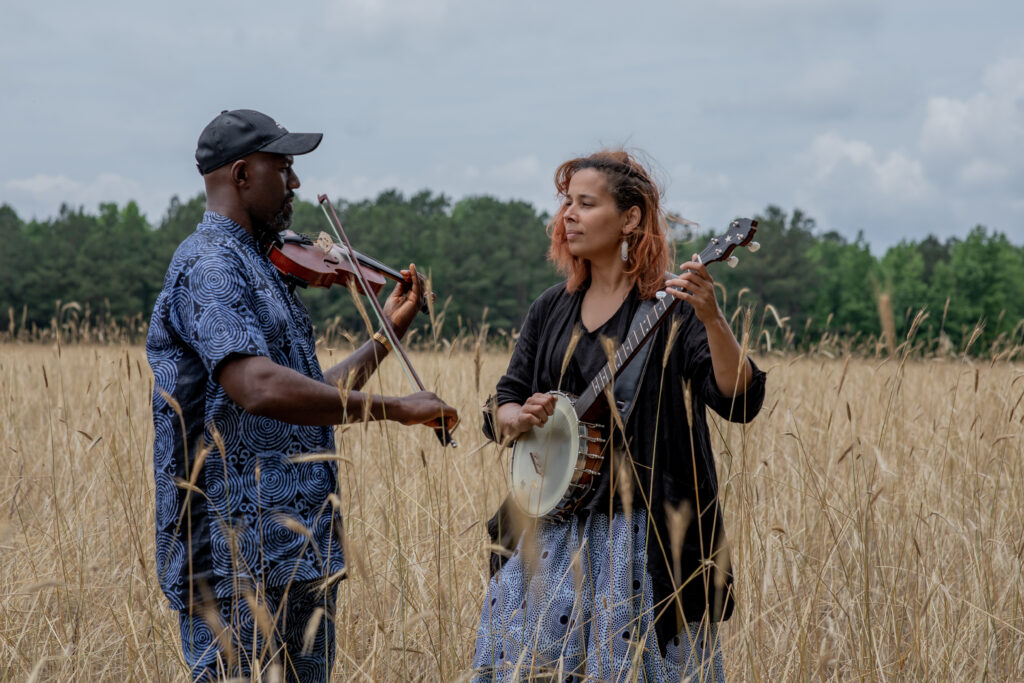
Rhiannon Giddens talks “stealth banjo” on Beyoncé hit, Biscuits & Banjos, and playing music for joy
Written by: Ian Saint
Rhiannon Giddens is a multihyphenate headlining act — as she was for last year’s Your Roots Are Showing music conference, where she was both the keynote speaker and a musical headliner in their Folk iN Fusion kickoff concert. But during our backstage interview in Killarney (County Kerry), Giddens emphasized her discomfort with celebrity and the business of music — preferring to elevate the banjo’s rich sonics and layered history, and spurring community and collaboration.
This spirit was reflected during Your Roots Are Showing’s conference set-up — which included a banjo workshop with Giddens and her latest album’s producer, Dirk Powell — and her own festival, Biscuits & Banjos, that just completed its 2nd year in Durham. Giddens subsequently announced the launch of Biscuits & Banjos Foundation, which NYS Music reports “will serve as a long-term home for cultural work that is too often unpaid or underfunded — investing in Black-led traditions and the artists, culture bearers, educators, and communities who sustain them.”
Tonight, Giddens returns to Dallas’ Longhorn Ballroom (216 Corinth St.) — supported by Texas’ own Nicky Diamonds — after the release of What Did the Blackbird Say to the Crow last spring. Texas’ Most Historic Music Venue is an appropriate venue for the album, that Giddens and her Carolina Chocolate Drops bandmate Justin Robinson recorded at historic sites like the homes of their musical heroes. A show at New York’s Carnegie Hall follows on Friday.
At first glance, the simplicity of Blackbird may be a striking follow-up to Giddens’ playing on Beyoncé’s epic Cowboy Carter — whose “Texas Hold ‘Em,” kicked off by Giddens’ banjo, made history as the first #1 single by a Black female artist on Billboard’s US Hot Country Songs — but for listeners whose interest in the banjo was piqued by “Texas Hold ‘Em,” it’s a delightful immersion to the ancestral roots of what Giddens has called the “Black Banjo Renaissance.”
Giddens spoke to Buddy’s Ian Saint during Your Roots Are Showing’s Killarney conference in January of last year. A transcript of their conversation, edited for length and clarity, follows.
IAN SAINT: The inaugural Biscuits & Banjos Festival bills a myriad of wonderful talent. Rissi Palmer and Joy Clark are friends of mine; Jake Blount in New Dangerfield, as well. Demeanor is a great live act. Of course, there is the very long-awaited Carolina Chocolate Drops reunion. That got me thinking about how much has transpired since y’all formed the band. Was that in 2005?
RHIANNON GIDDENS: Yes; that April was when I met Justin Robinson and Dom Flemons for the first times. Then the three of us started going down to see [old-time fiddle player] Joe Thompson later in the summer, and we became the Chocolate Drops in the fall.
IAN SAINT: So you formed around the time of Hurricane Katrina?
RHIANNON GIDDENS: I guess so. [pause] I guess so. I never thought about it.
IAN SAINT: I ask because that was, sadly, such a disproportionately cataclysmic time for Black Americans in a vibrant musical hub. A lot has changed in society and the music industry since 2005. From my personal vantage point, I feel that mainstream perception of the banjo has shifted. Would you agree?
RHIANNON GIDDENS: I think so. Not as much as I’d like — but there’s definitely a larger upswelling of support for the true history of the banjo, which is great. I’m really glad that that’s how you feel; but I’m still getting, “What about Deliverance?” for mainstream interviews. So there’s still a ways to go; but we’re definitely in a much different situation than we were 20 years ago, for sure.
IAN SAINT: Do you feel there’s wider acceptance for people curious to learn banjo?
RHIANNON GIDDENS: Yeah. In some ways, the advent of technological advances has been democratizing. And in some ways, it allows almost too much reliance on “what version?” and “which recording?” I’ve never been a tune collector in that way.
I don’t play a lot of tunes; and people didn’t play a lot of tunes back in the day. Most people played their repertoire of tunes, because there was no recording — if you wanted to hear the tune again, you had to play it again. People weren’t [constantly] demanding [new material]; and when you would learn new tunes, it was a slower process — then they would become part of you.
I just think that we go too fast [in the present] with these Trad. tunes — I get it, [the musician marketplace has] now moved into a performance territory. But I feel like there’s this disdain for the simple 15 tunes that everybody knows, because that used to be the social currency.
IAN SAINT: You’ve got me thinking about the musical icons of my Dallas neighborhood, Deep Ellum, and how there aren’t many recordings of our legends like Blind Lemon Jefferson, Robert Johnson, and Lead Belly.
RHIANNON GIDDENS: We have to remember that the recording industry is a hundred years old, and it’s really reshaped how we think of musicians. But for millennia before that, musicians were in a different place — and there’s some good from those times. Do I want cholera? No; but that doesn’t mean it was all bad. I am not looking to go back to any kind of utopia; but I think we can learn lessons from the pace of that life, and the idea of what that music was for. That’s what I keep asking, the older I get. I see new generations coming into it, who aren’t connected in any way to the older people who predate the industry.
My mentor [Joe Thompson] worked at a furniture factory his whole life. Then when he retired, he was rediscovered [as a musician] and had a whole second career performing. But when he was playing this music as a function of his community — playing for the Frolics or whatever — working [as a musician] wasn’t the same in his mind.
When we think about music only via having a music career, and people say “I’m not good enough to be a professional, so I’m not going to do it,” we’ve lost a lot. There used to be great pride in being an amateur musician and dilettante. That’s what you did when you came home: you just sat and played tunes, and did it [for enjoyment] for yourself and your family. But now there’s such a focus on the stage. “Oh, I can’t sing, I’m not good enough to be on whatever [show]”; and I’m like, “why would you divorce yourself from the participation aspect of it?” Just because in your mind, you’re not going to be a professional — whatever the Hell that means? I see that a lot [now].
IAN SAINT: To your point, in Deep Ellum’s musical origins, it was Black factory workers coming together after work…
RHIANNON GIDDENS: Yeah, and that music was providing a function for them. It wasn’t, “How good am I? Let me get some dollars.” It was like, “This is going to allow us to let it out and feel human.” And when music becomes divorced from its community function, it starts to eat itself. You see it with music now — even with quote-unquote “acoustic music” or “roots music” or whatever. A lot of the new people I see are very good at what they do; they’re very flashy and have all the chords, and that’s great, but it doesn’t move me personally like one chord and the same [timeless] old tune. I know I’m older, and [that can come across as] “get off my lawn” or whatever; but it’s not a generational thing to me. It’s really, “what’s the function?”
The Caroline Chocolate Drops, I think, we were providing a function as well as paying our bills. And I would love to not have to use [music] to pay my bills — but at this point, I don’t know anything else to do. [pause] Actually, I really make my money from other things. It’s less from performing, and more from lectures or books — which I like, actually, because then I can just do whatever I want over here [in music].
To be beholden to the strictures of the industry, as a musician, I think is really hard. And it’s really hard to keep alive those aspects of the music that are community function. My label, Nonesuch Records, is amazing; there’s not many like them. I said, “I want to do a fiddle and banjo record with Justin Robinson, and I’m not going to be singing,” and they were like, “okay.” I sent them the record and they were like, “All right, so we’re putting it out in April.” [What Did the Blackbird Say to the Crow was released last year.]
It’s just fiddle and banjo, outside with birds and locusts, recorded in North Carolina — where the music is from. Joe Thompson’s music, we recorded in his backyard. We did an Etta Baker tune (“Marching Jaybird”) at her house. And it’s just us. There’s no fancy arrangements. It’s like you just wandered up to our porch.
IAN SAINT: During your keynote at Your Roots Are Showing, you mentioned your favorite banjo to play is the 1858 replica. As I understand it, you said that gets referred to as a “minstrel banjo”?
RHIANNON GIDDENS: It’s a banjo, and it was used by minstrels. It was used by everybody at that time who wanted to play banjo — but it was popularized by minstrels, so it’s also called “the minstrel banjo.” And the tuning it was used for is called “minstrel tuning,” but it’s the banjo that people played — people in blackface, and [also] just regular people are playing those kinds of fretless, wooden hoop banjos. They’re really beautiful.
I like that banjo a lot because A.) it just connected to my soul, and B.) it’s a reminder of where the banjo comes from in a little visceral way, because the deepness of the tone is much more connected to those African ancestral instruments. And I like it because you don’t have to say anything; you just play it, and people feel something different than with the modern banjo.
IAN SAINT: Then I have to ask — ruminating on what you said about its mainstream perception, and because you hear the banjo before anything else in this hit song — is that the banjo you played on “Texas Hold ‘Em”?
RHIANNON GIDDENS: Yeah. [smile]
IAN SAINT: Wow. Because your banjo is the first thing we hear, and what gets us up on our feet. Not to place too much emphasis on charts… but it does seem significant to me that the first Black female artist to go #1 on the U.S. Country chart starts with this infectious banjo that was previously associated with minstrel shows, but people hear that banjo with a new association. What are your thoughts on that?
RHIANNON GIDDENS: Well, I played that banjo because that’s the banjo I play. And then I was like, “oh, it’s in the right key for this [song]? Aw, it’s meant to be.” And then that sound, people don’t connect to minstrelsy, which is good.
IAN SAINT: I hadn’t!
RHIANNON GIDDENS: It’s just an early banjo — and then there’s this whole other life it had, but there’s tons of Black people just playing this instrument as their instrument, and white people too. It became a commercial instrument, and then it became an instrument that everybody’s playing. And then, of course, it evolved 20 years later into something else; but it was a moment in time where Africa and Europe were really at a crossroads, and I believe you feel all the influences of American music in that banjo.So I thought [the groundbreaking success of “Texas Hold ‘Em”] was really powerful. And when you hear the banjo, you’re like, “that is a banjo, but it’s not the [modern] banjo that I [typically] hear.” And I am also hearing from other Black people that want to learn the banjo, but the modern banjo got too much association to minstrelsy, so they wouldn’t play it. They connect that to hillbillies and racism in that way; even though in the mountains, that’s where the most liberal people [in the south] were, but that’s not the narrative. And there were black people in the mountains, but that’s not the narrative. The narrative is this very narrow thing, and people are uncomfortable with that; but then they pick up this fretless or gourd banjo, and they’re like, “this is my way in.” That’s a reason why I ended up loving that banjo so much. I try to represent, as much as I can, a way into the music that feels good to folks — so I am really glad to hear that from people.
That banjo was in [2019 video game] Red Dead Redemption 2. The Mark Twain Prize for American Humor for Bill Murray, I played that banjo. I’ve snuck that banjo into more things, and people have no idea [the “minstrel banjo” stigma] — and I love that. It’s like “stealth banjo.” People are like “I don’t know why I like this banjo.” I can tell you why, because it doesn’t sound like the modern banjo — which needs rehabilitation, too, but that’s not my job. My job is to carve out space so that people can come to it in a fresh way, which is hard because of the narrative that’s been told.
IAN SAINT: You went to Oberlin College, half an hour west of my hometown, Cleveland. My NPR and PBS station is headquartered at Ohio University. It dawned on me that Destiny’s Child blew up while you were in college. It’s surreal to imagine you hearing Destiny’s Child in college, and learning that you’d play banjo on a groundbreaking hit for Beyoncé.
RHIANNON GIDDENS: It’s ironic, because I lost five years of pop music while in conservatory — all I was listening to is classical music and musicals. Whatever you’re learning, I believe you should just learn the hell out of it, because you can always apply the lessons that you learned. I apply the lessons I learned in classical music — learning this incredibly dense, complicated thing in a very short amount of time. I didn’t know how to read music or any of that stuff. What I had to do to [attain] that, I’ve applied [to other pursuits]. That’s why I didn’t put the banjo or fiddle down when I picked them up. I was like, “Oh, this is going to be freaking hard. But so was opera, so just get over it.”
I was not a party girl. I didn’t do anything socially other than just hang with a few friends. I was studying all the time, and I don’t recommend that either — there’s a balance. But I was so focused on being able to [study intensely] at a time where I didn’t have to work full time. [My advice to college students is] don’t waste that time. I mean, yeah, go have fun — but whatever you’re doing, get all you can out of it.
IAN SAINT: “Wring the sponge” is how I described my college approach.
RHIANNON GIDDENS: Yeah, I squeezed every freaking ounce — I was in debt to Oberlin for many years, so yeah, I got everything out of that college I could possibly get. And [I advise to] form those relationships — I’m still working with Oberlin people today. It’s really funny, because I used to call myself “Beyoncé of the Banjo” after somebody said I’m the Beyoncé of the folk world.
IAN SAINT: I LOVE alliteration!
RHIANNON GIDDENS: I do, too. I was a self-taught marketing designer after I graduated, because an opera degree and $5 will get you a very small coffee at Starbucks — so I had to figure out what I was doing, which really helped my music career. I did all the original Carolina Chocolate Drops album designs, and the website as I taught myself HTML. None of it was wasted [in setting up for my music career], you see what I’m saying?
IAN SAINT: Did you design the flyer for Biscuits & Banjos?
RHIANNON GIDDENS: No. At this point, I let the professionals do it. I was doing it when we couldn’t afford to pay anybody else. It’s a Durham-based [designer]. We did everything in town. There was my team, but then every producer, publicity, everything — we wanted to make sure it was not an extractive festival, but a community oriented festival.
I try to use whatever opportunity I’m given to lift up the music. It’s not about me; it’s never been about me, and that seems to be working all right. So I just keep the focus on the banjo, the music, and the history. I’m just the tool.
For Rhiannon Giddens tour dates and tickets, visit her official website: https://rhiannongiddens.com/.
For more information on the Biscuits & Banjos Foundation, visit https://www.biscuitsandbanjos.com/.
For more information on Ireland music conference, Your Roots Are Showing (taking place in Belfast from February 24-28, 2027), visit https://www.showingroots.com.


