


Amy Grant shares how collaboration aided her recovery, new album, and ‘re-energizing’ Ireland return
By: Ian Saint
After 13 years, Amy Grant finally has a new studio album out: The Me That Remains. The interim between albums included three perilous health matters — open heart surgery to fix a congenital condition, a very traumatic brain injury from a biking accident, and a five-hour throat surgery to remove a cyst that grew after the accident — and the death of her father, Dr. Burton Grant. Needless to say, Grant’s return to releasing new music is a hard-won miracle; and this wasn’t lost on her.
The Me That Remains sounds appropriate for where Amy is in life, but its presentation might surprise casual observers who perceive her as “The Queen of Christian Pop” and best recall her synthesizer-laden hits — 1991’s Heart In Motion, alone, sold over 5 million copies and produced four Top 20 singles on Billboard’s Hot 100 chart (including the #1 “Baby Baby”). Instead, Grant enlisted Mac McAnally — whose career began in Muscle Shoals, and is best known as the musical director for Jimmy Buffett and the Coral Reef Band — as her producer.
The new studio album is also Grant’s first to be released without a major label or Christian music partner, opting instead for marketing and distribution through Thirty Tigers. She told Variety’s Chris Willman that Thirty Tigers’ “artist-driven company” reminded her of Herb Alpert and Jerry Moss when she signed with A&M Records; and co-founder David Macias revealed that his first paid internship was at A&M.
Similar to The Me That Remains bearing more organic instrumentation than her most famous albums, Amy’s namesake tour features a scaled-down ensemble that just played Americanafest last week. Tonight, they play Dallas’s Longhorn Ballroom, recognized as Texas’ Most Historic Music Venue and a perfect fit for the new album. For tickets, visit here.
Amy Grant’s first 2026 performance was staged at Ireland’s music conference, Your Roots Are Showing, in Belfast last January. Grant headlined their Folk iN Fusion kickoff concert, which also marked her first time performing with McAnally and Coral Reef Band drummer Eric Darken. I interviewed Grant for NPR & PBS Ohio affiliate, WOUB Public Media; and our Belfast backstage catch-up, edited for length and clarity, appears in print below.
IAN SAINT: Congratulations on releasing “The 6th of January (Yasgur’s Farm),” the lead single and opening track for The Me That Remains. And for premiering its live performance at Your Roots Are Showing in Belfast, which I think is the perfect place — as Belfast is such a compelling center of reconciliation in recent history.
AMY GRANT: Yes. I did the Black Taxi history tour after I sang the song. I’d never been in a car in front of a peace wall. What I couldn’t help but think is, as humans, we keep learning the same lessons over and over again — and that our violence never accomplished anything good, and leaning into our connectivity is an important way to see the world and each other. To see our differences as, “Oh, you’re broadening my lens. Thank you. I couldn’t have seen it that way. I grew up differently than that. I saw it differently.” But it’s not an “either or” — it’s “How do we see this together?” And with that song, all the references are very American. Like every song, I hope it makes people curious and start a conversation — because what a song means, every writer has to set the song free to become whatever it’s intended to become for the listener.
IAN SAINT: It’s interesting you say that. I just thought about how the title has “Yasgur’s Farm” in parentheses. I don’t feel Yasgur is a household name; but in your song title, you start a conversation about who he was. Was there intentionality with making sure he’s somehow in the title?
AMY GRANT: Piquing curiosity, once again. I didn’t know much about Max Yasgur [before reviewing the song], either. It was so interesting to hear about this man, and the farm he lived on that welcomed the Woodstock audience. He was told maybe 40,000 people would attend — of course, it wound up being over 10 times that.
But it’d been such a rainy [summer] that year. He was not able to [produce] the hay to feed his 650 cows. And being paid for a music festival on his farm was like, “Oh, this is the answer to my need.” And then how it turned out, half a billion people attended Woodstock — and his town was so furious with him that he became the disenfranchised. He wasn’t welcome at the general store. But when he’s looking at that audience, he said, “You came to enjoy music and have fun, and you’ve done that. The world could learn from you.” And this Vietnam War supporter, who was a conservative farmer, did the peace sign. A festival promoter [Woodstock co-creator Michael Lang] said the real hero was the man that broadened the way he saw the world to include our dream.
But it changed Yasgur’s life in a hard way — and I do feel like part and parcel with being willing to not wear a team jersey, but [instead] to provide a welcome table, is not always a happy ending. Status quo is easy; but to welcome, to start conversations… Anybody that’s ever done anything monumental — whether it’s Martin Luther King, Bobby Kennedy, Jesus — life is messy, because people are messy. And that’s part of being part of the human story.
IAN SAINT: That’s deep. And I can’t believe Your Roots Are Showing was your first time playing with Mac McAnally. [For more background on why Grant chose McAnally to produce her new album, read our NPR Ohio interview last year.]
AMY GRANT: And Eric, too. Oh, my God, the rehearsal — I had so much fun! Those are two talented, talented artists.
IAN SAINT: And you played the strumstick for the jam at the end.
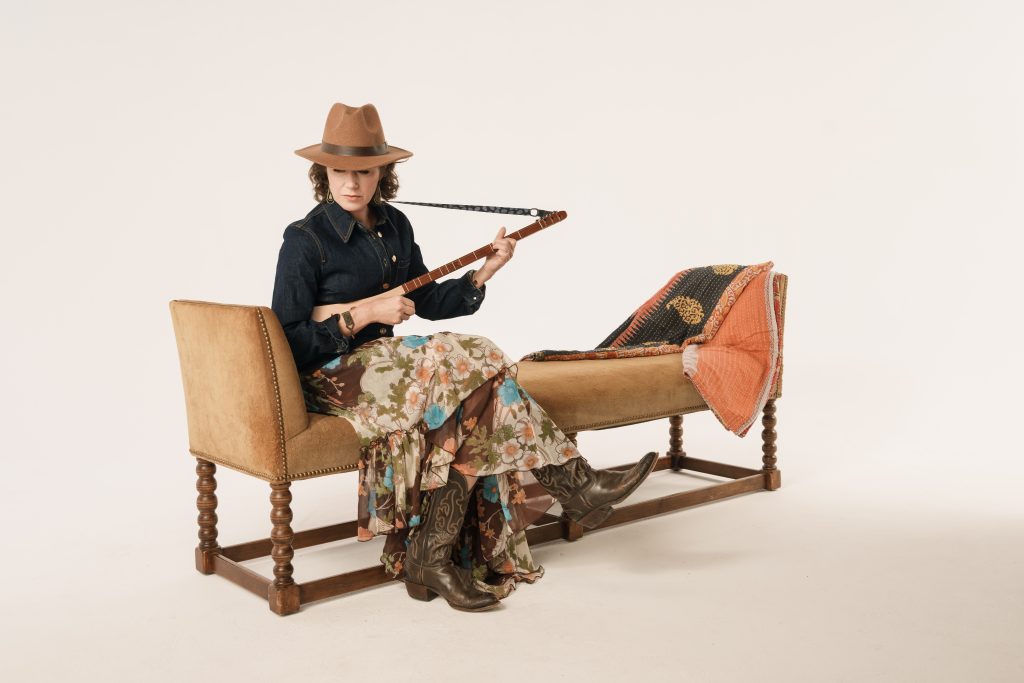
AMY GRANT: I did. The strumstick is the easiest thing in the world. It’s tuned in a fifth, so anybody can play it. You just have to tune it to the right key.
IAN SAINT: I was struck by Mac playing your old songs, too — particularly the way he approached your Heart In Motion hits, which famously shimmered with synthesizers and drum machines, in your smaller and acoustic configuration. Bringing Bryan out to play harmonica on “Baby Baby,” and Mac playing that searing lead electric guitar part for “I Will Remember You” so beautifully on acoustic guitar.
AMY GRANT: Right. Well, just making music makes fun experiences. I just finished a Christmas tour with two other artists, CeCe Winans and Michael W. Smith. [Read my interview with David Hamilton, the musical director for this Christmas show, including his remarks on working with Amy.] Before I left home, Vince said, “You are going to have so much fun getting to play with other musicians from other people’s bands.” [Grant is married to Vince Gill, whom I interviewed last year.] Because when you have a life in music, in a way, it feels like you’re in your own unique mole run. When you love something, you have to commit most of your energy to that — you’re part of a community, but you’re working so hard in your own lane.
That’s why a gathering like this [Your Roots Are Showing] is so much fun, because you pop up out of the mole run. I get to meet this person and that person, and play with all these new faces. I’ve known Mac for a long time, and Eric as well — over 25 years — but we’d actually never played together.
IAN SAINT: When you performed “Baby Baby” at the 1992 Grammys, I remember you brought your toddler daughter Millie — who inspired the song — on stage. Then I realized, Your Roots Are Showing was your first time performing “Baby Baby” in Europe since Millie became a mother herself.
AMY GRANT: That’s right.
IAN SAINT: Do you have thoughts like that going through your head as you’re performing?
AMY GRANT: I do. I mean, my thoughts are unique to me; but in the same way that a listener can hear a song that’s been part of their listening repertoire for 20, 30, or 40 years. I’ll go, “Oh my gosh, I remember the first time I heard that song.” Now I’m seeing faces of all my friends before we were grown and haired over — I remember us all as 12 year olds. That’s the beautiful thing about music: it all comes back. My experience with the song, and your experience, is going to be two different things. But that’s the mystical quality of music: we are in two completely different lives — two different lenses through which we see life, ourselves, the world — but we can sit beside each other, a rhythm starts, and we’re both moving and singing. Music is the most amazing connective tissue.
IAN SAINT: It is. That’s the perfect segue for your new album’s title track, “The Me That Remains.”
AMY GRANT: Yes. That was a lyric I wrote a couple of summers ago. I sent it to Mac and said, “Do you have any interest in helping me with music for this? No sacred cows — change anything you want.”
IAN SAINT: So the title track was your bridge to collaborating with Mac, and him ultimately producing The Me That Remains?
AMY GRANT: Yes. I had a bike accident in ‘22, and it’s taken a long time for my short-term memory to come back. When it comes to writing songs, a lyric is right in front of you — so you can change a lyric, but a melody idea is so elusive. You might have something that you love; but then two minutes later, I can’t remember it. So trying to write for this new project, I found myself reaching out to many people, because I felt so handicapped in the music department — I’d start working on an idea and record, but then three hours later I’d go, “What 20 seconds am I looking for?” I just couldn’t find my way back to whatever I thought I was doing.
But then it was beautiful, because it made me actively reach out to some different people. “Will you help me with this song?” That [question of] “Will you help me?” is a very disarming way to start a collaboration.
IAN SAINT: Speaking of collaboration: what are your thoughts on the experience you’ve had at Your Roots Are Showing, playing in Belfast with artists at different stages of their careers from every continent?
AMY GRANT: I feel so re-energized. None of our instruments made it [to Ireland], by the way — we were playing on everything borrowed, except the strumstick that I had under my seat. This experience lit a fire in me, to participate in other people’s music, that I have not ever experienced in my life. I mean, I started writing songs when I was 15, so I immediately had opportunities to record and tour — so I was never even in a cover band. I never had a gig where I learned 100 of my favorite songs. Our youngest daughter [Corrina Gill] is in a couple of cover bands, and I’m like, “Oh my gosh, it’s very important for you to know this music from the 50s, 60s, 70s, 80s.”
So there’s this whole part of my music education that I’m having to go back to now, in my 60s — just me and that strumstick, going, “Okay, something basic as music theory.” I’ve always been able to hire good guitar players. I can kind of [figure] out the bass note in one line, or I’ll learn [to play] my songs after they’re written, even if I wrote the music, because I’ve just always had other great people with me — I sleep with a great guitar player! [laugh] My husband [can just ask], “What do you want this to sound like?”
I was so inspired by this artist, Wallis Bird. [Bird is an Irish artist who also featured in the Folk iN Fusion concert.] She gets up there all by herself, and it didn’t matter what the tempo was — she brought so much life to every song. I went back to my hotel room and I was like, “Well, if it were me and the strumstick for the rest of my life, I better get my stuff together and know how to do something that conveys what I’m thinking and feeling.” I’ve been back in my room like, “Okay, theory. Where is 1, 4, 5 on this? There’s the minor second; there’s the minor sixth.” I’ve never had to learn all that basic stuff. And I’m like, “Well, if you want to be a part of the movement, learn how to move.”
It’s interesting how, whatever our path is — whether it’s feast or famine — everything has opportunities and limitations. Every good thing in life that happens also has a hard side. Every awful thing that’s happened to anybody, somewhere in there, there is the seed of something good. Might not feel it right then, but later — whether it’s ““my compassion is enlarged,” or “I understand a bit more about human nature.” Nothing exists totally as good or bad.
Amy Grant’s The Me That Remains Tour plays Longhorn Ballroom (216 Corinth St.) tonight. For Amy Grant tour dates and tickets, visit https://www.amygrant.com/tour.


