


COVER STORY: As Eagles wrap farewell tour, Don Henley discusses his Texas roots, dream collabs and lessons learned
Written by: Ian Saint
Cover photo by: Chloe Weir
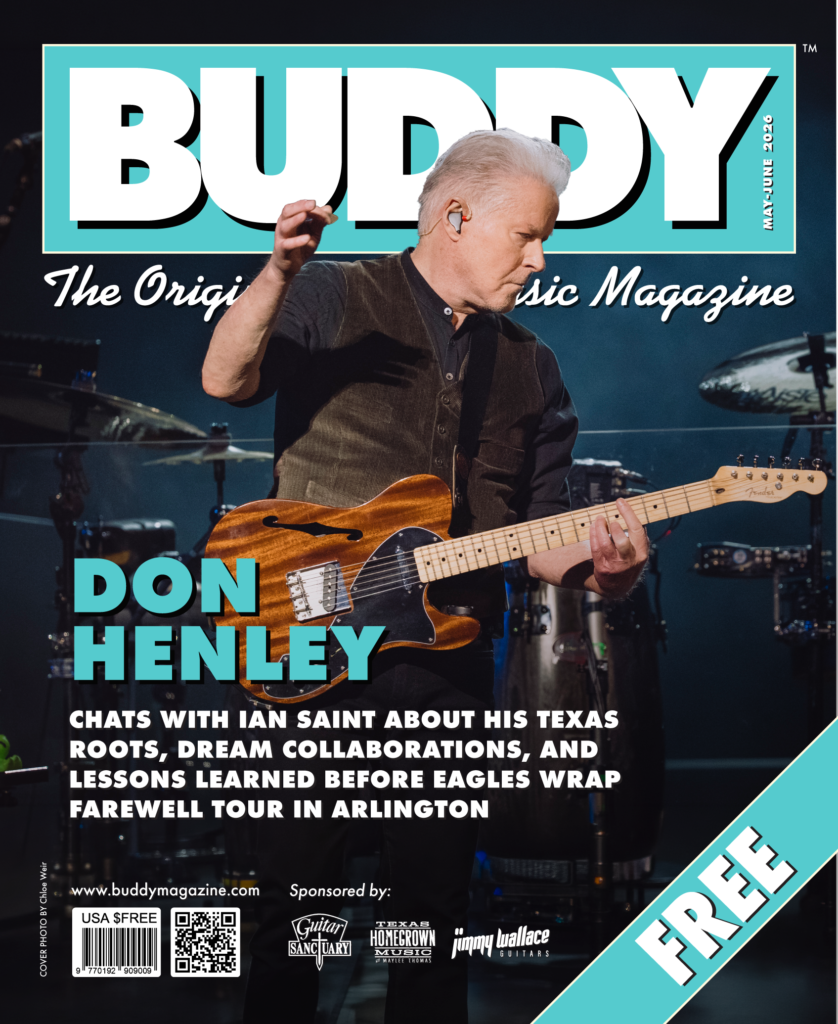
After Saturday, the Eagles are done touring. Their captain, Don Henley, is emphatic that Saturday’s Long Goodbye tour stop at Globe Life Field in Arlington — located in the DFW metroplex where he lives, and the closest MLB stadium to his hometown of Linden — will be the farewell tour’s final show, for a variety of reasons he’ll explain to Buddy Magazine.
Tedeschi Trucks Band support the Eagles at the Texas Rangers’ home turf on Saturday, and tickets can be purchased here. After the Arlington concert, all that remains on the Eagles’ concert calendar are six more dates of their Sphere immersive show in Las Vegas — two in September, four in November. The general public ticket sale begins at 12 PM Central on Friday.
Don Henley seldom does interviews these days — particularly on tour, when vocal rest is paramount. But he has a soft spot for Buddy Magazine, the Original Texas Music Magazine with whom he shares a long history. In fact, he ordered subscriptions for himself, Eagles co-captain Glenn Frey, and Texan-Californian collaborator JD Souther in a 1980 letter to the editor (below).
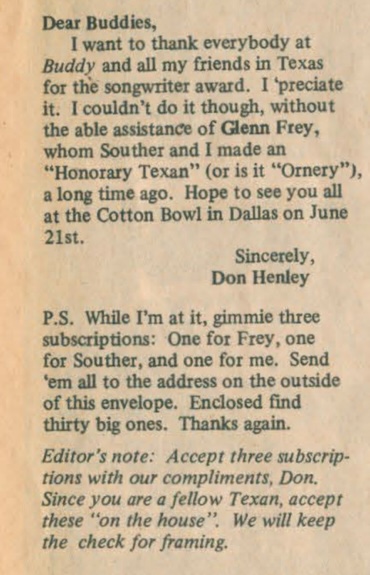
Sadly, the Eagles imploded literally the month after the June 21 show at the Cotton Bowl that Henley referenced. But he kept in touch with Buddy as he navigated his new journey (in a new decade) as a solo artist. In 1984, he spoke with Buddy for a lengthy interview about his Texas upbringing, taking flight with the Eagles, and finding his footing on his debut solo album I Can’t Stand Still.
Henley was Buddy’s cover story for the April, 1985 issue, after sophomore solo album Building the Perfect Beast was released. He got candid about the complicated feelings behind embarking on his first solo tour (and performing a few Eagles songs without them), becoming a frontman (he was studying mime and various dance styles), experimenting with synthesizers and drum machines, the widely divergent aesthetics between Henley’s and Frey’s solo albums (the latter had released No Fun Aloud and The Allnighter), and the awkwardness of embracing MTV in his late 30s. A few months later, though, Henley won Video of the Year at MTV’s second Video Music Awards.
There could well be more correspondences and photos with Henley in Buddy’s archives, including from the Texas Music Awards ceremonies that he participated in. Buddy’s longtime publisher Ron McKweon died in 2024. Current publisher Rob Garner is in the midst of poring through the troves of pre-Internet magazine issues, documents, and photos (some undeveloped) he left behind for a sophisticated digital archive of Buddy’s 53 years. A few dozen back issues (mostly in the mid-70s) have been scanned and uploaded to our site here. You can contribute to Buddy’s full digitization project fundraiser here.
This last show on the Eagles’ Long Goodbye tour will be the first since DFW’s own Christopher Holt joined the Eagles ensemble. Holt played on Henley’s 2015 solo album, Cass County, and joined him on the subsequent tour. Buddy Magazine had a cover story with Holt in 2024, where he expressed “I’d love to keep working with Don if he wants to do another tour anytime.” The following year, Holt played his first Eagles show after longtime live guitarist Steuart Smith retired for medical reasons.
I sat down with Don Henley in Nashville on Monday afternoon, to discuss a variety of endeavors in addition to The Long Goodbye concluding in Arlington on Saturday.
— The Eagles’ Sphere residency
— The Eagles’ relaunched SiriusXM channel, with Don’s playlisting
— One of These Nights deluxe edition (including a never-before released live recording from Bernie Leadon’s last Eagles concert and Joe Walsh’s first appearance)
— The End of the Innocence remastered 1989 solo album reissue, due June 5
— Henry David Thoreau PBS documentary that Don executive produced with Ken Burns
A transcript of our wide-ranging conversation, edited for length and clarity, follows.
IAN SAINT: I just spoke with our mutual friend, Louise Goffin, who wants to send you her best wishes.
DON HENLEY: Oh, wow. I haven’t seen Louise in years. I wish her well, too. She’s a good girl. What is she doing?
IAN SAINT: Louise just released a new single. And she does a wonderful job of running the Goffin & King Foundation, supporting aspiring singer-songwriters. [Louise is the first child of Carole King and Gerry Goffin.] They had a sold-out round at the Bluebird Café a couple summers ago, and I caught them at Opening Bell Coffee in Dallas. Louise told me today that “Don is one of the great American songwriters.”
DON HENLEY: Well, thank you. Louise is great. And her mom [Carole King], of course. I opened for Carole at Hyde Park [in 2016]. Carole was 74. I was the opening act, Louise was there [as the first opener and also accompanying her mother] and that was the last time I’ve seen either one of them.
IAN SAINT: I sent Louise your 1984 Buddy Magazine interview, and she was so honored that you told us one of the reasons you partnered with Danny Kortchmar for your solo albums was “I’d liked the production he’d done on Louise Goffin’s albums.” [Kortchmar also played on Carole King’s first several albums, including Tapestry.] Louise said that you and “our dear, late friend JD Souther” sang on “Singing Out Alone” — the closing track of her debut album, 1979’s Kid Blue. Then Louise sang on “Johnny Can’t Read,” which I believe was your very first solo single in 1982?
DON HENLEY: Yeah. It flopped. [In fairness, “Johnny Can’t Read” reached #42 on Billboard’s Hot 100.]
IAN SAINT: Well, you had a huge hit right after! [laugh] The next single, “Dirty Laundry,” went Top 5 and Gold, and won Buddy Magazine’s 1983 Texas Music Award for songwriting.
DON HENLEY: Well, I never planned on being a solo artist; I just didn’t think about it. I’m a band guy — I’d always been in bands — and I was sort of forced into that position by the breakup of the Eagles, and I was pretty lost for a while. I was just adrift, rudderless, and depressed. Then I met Danny Kortchmar. I think Betsy Asher always had a party on the 4th of July, and I met Danny there. I think we had a few drinks and stuff, and became friends. I needed a partner. We decided that he would be my new writing partner, and he was very enthusiastic about it. As you know, he’s an incredible musician and extremely talented. He sort of pulled me up out of the hole that I was in.
IAN SAINT: Beyond the immense pressure of kickstarting a solo career, I’m gobsmacked by how drastically the industrial and societal landscapes changed in just two years. When the Eagles concluded touring in 1980, Jimmy Carter was still President and MTV hadn’t yet launched. When your first solo album (I Can’t Stand Still) came out in 1982, the Reagan administration and MTV were in full swing.
DON HENLEY: Yeah, things were changing fast. MTV was something that a lot of people — especially in my generation — were not ready for. It was hard enough being a writer, recording artist, and live performer; and then having to be a performer in videos, as well, was extra [pressure]. Some people took to it like a duck to water, they were just great with it; I was not. I was very reluctant to do that. You had to find the right director, and there was a lot of competition to find directors because they were getting approached by a lot of musical stars.
So that whole transition period in the beginning of the ‘80s was pretty tough. I didn’t really get my footing until 1984, 1985 — Danny was a big part of it, and Greg Ladanyi, the great engineer. But I got encouragement from a lot of people. I had a piano in the living room; people would come over to my house and we would jam. Kenny Edwards was really supportive of me; I remember him coming over and working with me for a while. But Kootch — that’s what we call Danny — was the real spark plug.
That first album was difficult. As you said, we released “Johnny Can’t Read” first. In retrospect, I was trying to follow the New Wave trend; that song was meant to be kind of a New Wave pop hit. Didn’t work. I even recorded that song in French and Spanish! And trying to have an international audience in it didn’t work. Then some program director or DJ — I can’t remember who — heard “Dirty Laundry,” called [Eagles manager] Irving Azoff and said “That ‘kick ‘em when they’re up, kick ‘em when they’re down’ thing? That’s hit material. You should release that.” So they did, and that was really the kickoff of my solo career.
IAN SAINT: I love that when facing the pressure of your first solo album, amid rapidly shifting times, you leaned into your roots and paid sweet homage to your late grandmother. In 1984, you told Buddy Magazine that your grandmother “used to sit in a rocking chair, day after day, singing ‘The Unclouded Day,’ which I put on my album.” And that nod to your grandmother is your debut album’s closing track. [On a personal note, I was especially touched by this grandmotherly homage because Don is my first cover story interview since my grandmother Eileen died on Valentine’s Day.]
DON HENLEY: Yeah. My grandmother lived with us. My grandfather died in 1942, five years before I was born, so I never knew him. My mother being the only child and good daughter that she was, took her mother in. She would sit in her rocking chair and sing that, and Stephen Foster songs like “My Old Kentucky Home” and “way down up on the Suwanee River” [“Old Folks At Home”] and all that stuff. I told Kootch that “Unclouded Day” was one of the things she sang. [The Staple Singers released a popular rendition in 1956, that Bob Dylan told AARP in 2015 was “the most mysterious thing I’d ever heard.”] Kootch said, “We should do a reggae version of that.” I went, “How are we going to do that?” [laugh] So he got [Ras Baboo on percussion and timbales]. It was fun to do, and my mother enjoyed it. [Note also that Bill Withers sings backing vocals on this track.]
IAN SAINT: Regarding MTV, it’s interesting to hear your discomfort with music videos, because you quickly played a big role in revolutionizing music videos — even for artists whom MTV made huge stars of, like Madonna. “The Boys of Summer” was directed by Jean-Baptiste Mondino, who went on to direct “Open Your Heart” for Madonna — that music video was where Madonna first debuted her iconic bustier, with the pointy “assets”…
DON HENLEY: Which seems very tame now. [laugh]
IAN SAINT: Yeah, that’s right. [laugh] But it was directed by Mondino, and I had no idea that you were the very first non-French artist to work with Mondino on a music video.
DON HENLEY: Before Madonna?
IAN SAINT: Yes. Madonna shot “Open Your Heart” with Mondino the year after “Boys of Summer” won the 2nd ever VMA for Video Of The Year in 1985.
DON HENLEY: Oh, okay. I wasn’t expecting any of that, either. I was very uncomfortable in videos. My appearance in that video is me on the back of a truck, driving through the streets of Van Nuys. I have to give credit for that video to Jeff Ayeroff at Warner; he was very good at videos and finding new directors, and Jeff got Mondino to me.
I’d done a couple of videos before that, with various directors who didn’t really seem to care about what the song was about. It became all about them and their vision; they didn’t really ever talk to me about what the song was about, or what I thought — they would just do their own thing and direct me. Mondino was the first guy who actually came to my house and sat down with me one evening. We talked for 3-4 hours about the song, and what my vision might be for a video; and I was really impressed with that. He was a very down-to-earth guy. He was a still photographer first — that was how he made his name, by doing still photography. He did that video, and it was brilliant.
That little kid in the video [Josh Paul] is grown up now, has kids of his own and he’s still a drummer. [Josh Paul told EMG Pickups that Don “showed me cool things about drums and took me to the studio where I got to watch him work. I was too young to appreciate how generous he was with his time, but he really taught me a lot about music and life. It was an invaluable experience I’ll never forget.”] I ran into him several years ago at a rehearsal hall in The Valley [of Los Angeles]. And that was a really great video. I’m the worst thing in it.
IAN SAINT: [laugh] Well, you swept the 1985 Video Music Awards, including Video Of The Year! It certainly blew the door open for Mondino, too, as he went on to direct Madonna in some of her most acclaimed videos — like “Open Your Heart,” “Justify My Love,” “Human Nature,” and “Don’t Tell Me.”
DON HENLEY: It really took my career to another level. We still use parts of that video in the live show at the Sphere. You can’t blow it up [around the entire Sphere screen] because of the technology, but we’ve figured out a way to insert it into the Sphere screen — we shrank it into a drive-in movie scene. Yeah, that’s still a beautiful video. I’m always partial to black & white movies. I credit Jeff Ayeroff and Mondino himself for coming up with that whole concept.
IAN SAINT: Speaking of that imagery of you as a young boy playing drums, your mother Hughlene bought your first drum set — a Red Sparkle kit — at McKay’s Music Company in Sulphur Springs. It’s still in business all these years later, under new ownership and now named The Band House.
DON HENLEY: Yeah. Mr. [Kenneth] McKay is deceased and sold it to a younger guy years ago. [Sulphur Springs News-Telegram reported that McKay sold it in 1980.] I went in there several years ago and bought a Fender amplifier, I think, just for old time’s sake.
IAN SAINT: That Sulphur Springs drums purchase was a pivotal moment for you. What feelings do you have about the Eagles’ Long Goodbye tour concluding in your home region on Saturday?
DON HENLEY: Well, it’ll probably be the last time that we perform in Dallas — or even that I perform [altogether] in Dallas. I’m not all that emotional about it, frankly. I mean, I hope we have a good show; I hope that the weather is good. I think it’ll be a bigger deal for Chris Holt — he was my kids’ guitar teacher. He’s going to have a lot of friends there, a lot of eyes on him, and I’m sure he’ll do fine. He’s a veteran now; he’s accustomed to this gig with the Eagles, and he’ll be fine. I’m not particularly emotional about it, or nostalgic, or any of that stuff. Again, I just hope we have a good show and good weather — and that’ll be our swan song in Dallas. I’m glad we’re at the baseball stadium, and not the football stadium.
IAN SAINT: It’s interesting to compare and contrast the Cowboys stadium with the Cotton Bowl.
DON HENLEY: Yeah, we played the Cotton Bowl, in… gosh…
IAN SAINT: 1980.
DON HENLEY: Was that when it was? I thought it was earlier than that.
IAN SAINT: You probably played the Cotton Bowl more than once, but you definitely did the Texxas Jam in 1980 — Buddy published your letter to the editor in 1980, stating “Hope to see you all at the Cotton Bowl in Dallas on June 21st.”
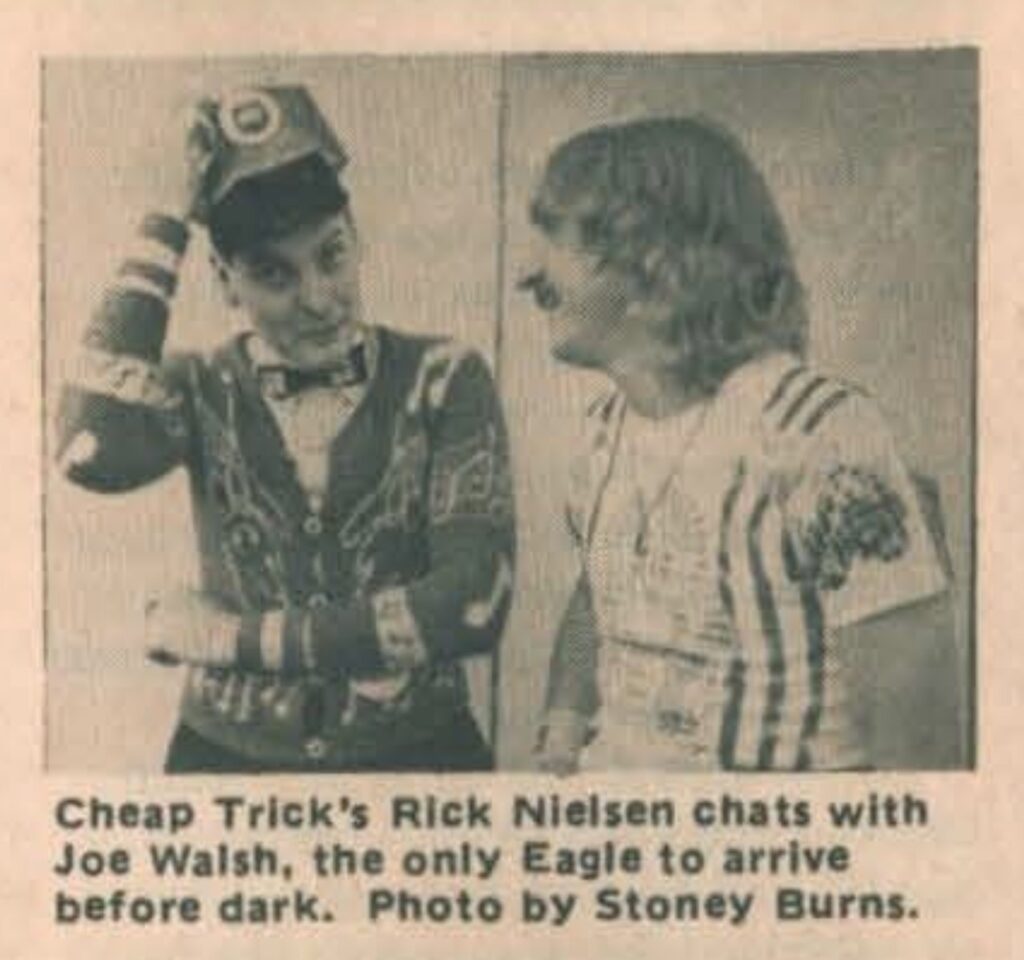
DON HENLEY: Yeah, and I remember it was hotter than Hell — it was just unbelievably hot. I can’t remember who was on the bill…
IAN SAINT: In 1980, the line-up included Foreigner, Cheap Trick, Sammy Hagar, Christopher Cross, April Wine, and Point Blank from Irving.
DON HENLEY: Oh, okay. I think we’d played there before.
Henley is correct. The Eagles played Cotton Bowl on July 6, 1975, supporting The Rolling Stones on their Tour Of The Americas ’75 — which was the Stones’ first tour with Ronnie Wood replacing Mick Taylor. Keith Richards was charged in Arkansas with reckless driving and illegal knife possession the night prior. Other support acts included Montrose and Trapeze. Interestingly, the tour logo was a fusion of a jet and eagle.
The Eagles had just released One Of These Nights when they played the Cotton Bowl in 1975, and the Randy Meisner Retrospective and Randy Meisner Hearts On Fire fan sites nicely compiled press clippings, photos, and video. Speaking of One Of These Nights…
IAN SAINT: One Of These Nights was just reissued as a deluxe edition, and the second disc includes a very special live show recording: the Sunshine Festival in Anaheim on September 28, 1975. I believe this was the Eagles’ last show with Bernie Leadon, and his future replacement Joe Walsh appeared for the Eagles’ first performance of “Rocky Mountain Way.”
DON HENLEY: Yeah, they found the live tape. Everybody forgot about the recording; it had been sitting in the record company vault for 50 years. Somebody stumbled across it last year, and I spent a couple of months last summer mixing it. It’s some good stuff on there. I was pretty impressed with [the quality]; I mean, it was recorded with a truck. I don’t remember who the engineer was, but I think it was the Record Plant [recording studio] truck. It took the engineer a couple songs to get things dialed in; the first couple of mixes were pretty rough, but then later on it became pretty good. Randy Meisner was incredible — some of the bass stuff he was doing was mind-blowing, and of course his voice. [Below is “Take It to the Limit” from that show, which Randy co-wrote and sang the lead vocal.]
So that live [performance has] come out as an adjunct to the remix of the studio album. They were supposed to put that out last year, because that was the 50th anniversary and somehow it slipped. So now it’s in the same year that Hotel California turns 50, which will be this December — and they’re redoing that, too.
IAN SAINT: The Eagles were remarkably prolific — your first album and Desperado were released only 10 months apart, then On the Border dropped only 11 months after Desperado. So I see how easily the anniversaries can blur, because you guys put out so much so quickly.
DON HENLEY: Yeah, I don’t know how we did that. [laugh] Because we were touring, too. We would sometimes do a show, then fly back to wherever we were recording and go into the studio at like 4 o’clock in the morning. There was a lot of pressure from the record company; because back then, once you had some momentum going, momentum is very important — they wanted product, and they wanted it quick. Of course, that changed as the years went on; it took us longer and longer to make an album. Depending on when your big break comes, you have twenty-odd years to write your first album. Then after that, you have like 6-8 months to try to fill the well up again, and come up with new ideas and new material — it gets more difficult as time goes along, and you get that pressure. We finally achieved a level of success that took some of that pressure off us; the record company would back off and leave us alone for a while.
But yeah, we were pretty prolific. There’s a certain uneven quality to the first three albums — some of the songs aren’t exactly gems — but that’s normal, I think. Then [fourth album] One of These Nights, that was the best we had done up to that point. Then they released the Greatest Hits album [in February, 1976] without even consulting us. [laugh] At the time, we were angry about it. We said, “We don’t have enough hits to have a greatest hits album.” But they did it anyway, and it turned out to be what they tell me is the largest selling album in [U.S. history].
IAN SAINT: Probably forever.
DON HENLEY: I don’t know; maybe Taylor Swift or somebody will surpass that at some point.
IAN SAINT: “One of These Nights,” the title track, blows me away every time — the way you wail so high-pitched and soulfully at the end, I never would’ve guessed that’s a white man from rural Texas. [laugh] In your 1984 interview with Buddy Magazine, you told us that “Linden was totally segregated until I got out of high school.” But you also told us that “behind my house, there was a good sized pond where, on certain Sundays, Black people from the area would have baptisms…. I used to sneak down and hide in the weeds and watch” and “the people sang their butts off.”
DON HENLEY: Yeah, it was great; that was part of my growing up. My hometown is very rural. There was a pond down behind my house, that belonged to a guy named Marion Hamilton — it was fed by a spring on our property that belonged to my grandfather. I’d go down there and catch crawfish and tadpoles, and just play. It was a great way to grow up — complete freedom, just wandering around with my dog and doing whatever I wanted.
I saw a couple of those baptisms. I remember they all wore white, and the preacher had this leopard skin Tarzan outfit on. They would wade into the water, he was very old fashioned and they would sing. It was a wonderful thing. I wish I’d been able to film it, because it was like something out of a movie.
IAN SAINT: I wonder if that inspired your vocal performance on “One of These Nights”? That outro sounds like it could’ve been a dramatic baptism! [laugh]
DON HENLEY: Well, there was a lot of gospel music in my upbringing — in church, on the radio, and with my grandmother — and the part of Texas I grew up in was a musical crossroads. It was up in the [northeast Texas] corner near Louisiana and Arkansas, [with] all those influences. There was bluegrass and mountain music that came down from the Ozarks. [The Eagles] were just in New Orleans [for the New Orleans Jazz & Heritage Festival], which is its own planet.
There was a 50,000 watt radio station in New Orleans called WNOE, that I could get at night. Back then, disc jockeys were allowed to play regional music before everything got homogenized by corporate radio. WNOE would play Fats Domino, of course, who was from New Orleans. They would play Ernie K-Doe, The Meters, Allen Toussaint, Clarence “Frogman” Henry, and Piano Red — who was also known as Dr. Feelgood, a mulatto guy who played incredible boogie-woogie piano.
And then there was also that station in Nashville [WLAC] with John R, the famous DJ who everybody thought was Black, but he was a white guy. There were stations in Dallas that I could get. So I heard music from all over the place. Lead Belly lived in Shreveport for a while, and I’ve been to his grave a couple of times. It’s in a small cemetery behind this tiny church near the Louisiana border, [Shiloh Baptist Church in Mooringsport] out in the middle of nowhere. It’s interesting because it’s a very humble graveyard with a lot of small tombstones — some people couldn’t even afford a tombstone, they just drive a pipe into the ground — and then he’s got this giant marble monument. I’d like to take John Fogerty down there someday.
IAN SAINT: Don Henley taking John Fogerty to Lead Belly’s grave would be a memorable moment!
DON HENLEY: I think he’d get a kick out of it. And then there’s Caddo Lake nearby, where you can fish. Yeah, there was a music scene in Shreveport — a lot of stuff came out of there. Louisiana had as big of an influence on me as Texas did, because we lived near the border.
IAN SAINT: I’ve stayed in Texarkana before, and love that region for that blend of influences.
DON HENLEY: My first band played a lot of gigs in Texarkana. We’d play the Shriners and Elks, the country clubs and all kinds of stuff in Texarkana.
IAN SAINT: Speaking of your first band, Buddy has 45 RPM singles by the Four Speeds in our archives…
DON HENLEY: Ewww!
IAN SAINT: Well, I’m sure they’re great — but we won’t put them up for streaming or anything. [laugh] The “El Santa” record says it’s a Harold T. Crabbe Production.
DON HENLEY: Harold was from Texarkana, and he was our manager for a while — great guy — and he started a label called Crabbe Records. Sometime in the ‘60s, we went to Dallas. I don’t know if it was through Harold or what, but we met with Dale Hawkins — the guy who wrote “Susie Q.” He had offices in the Inwood Towers, and he decided to produce us. I think we only had one session with him, and he was in the studio waving his arms around like a conductor. [laugh] Whatever we did, didn’t amount to much. And I remember recording somewhere else in Dallas, in the warehouse district — I guess it’s probably the Design District now.
We recorded at Robin Hood Brians’ studio in Tyler one time. He takes credit for telling me to turn my left hand drumstick around backwards, but I think it was more due to Ringo Starr than it was to Robin Hood. The stick is backwards because you can be louder. I started playing with traditional grip; I was in the marching band, I studied the rudiments and Frank Arsenault and all that stuff. I won a couple of patches at regional band contests in the marching band; but at some point, I turned the stick around, and you have less finesse that way. My friend Stan Lynch still plays the traditional way, but he’s a big guy and he can hit the drums harder.
IAN SAINT: Going back to Lead Belly, I live in Deep Ellum and we love him. There’s a lot of history with Lead Belly there, and Robert Johnson…
DON HENLEY: Yep, and T. Bone Walker — he was born in my hometown, you know. He wasn’t there long, but he was born there. And Scott Joplin, I think he moved to Texarkana but was born in my hometown. I actually wasn’t born in Linden. I was born in Gilmer, Texas because my mother was having a difficult pregnancy. Something went haywire — she never explained to me what it was — so they went to Gilmer, because there was a famous clinic there called the Ragland Clinic. And Gilmer is where Johnny Mathis was born.
IAN SAINT: Wow, I was just talking about Johnny Mathis with Vicki Lawrence for an upcoming Buddy interview. She was in The Young Americans, and they performed with Johnny in the ‘60s.
DON HENLEY: I’ve never met the guy. I understand that he’s retired now. I’d like to just see him sometime and go, “Hey, you know, we were both born in Gilmer.” But he wasn’t there long, either. [Mathis moved to San Francisco at age five.]
IAN SAINT: Your third solo album, The End of the Innocence (1989), is newly remastered from the original analog tapes and will be re-released June 5 on 180-gram double vinyl. The Waters Sisters sang on “Heart of the Matter,” and they’re also from Texas.
DON HENLEY: Yeah. They also sang on “Everybody Knows,” the Leonard Cohen song that I covered for the greatest hits album. There had to be three new tracks when I put out [1995’s Actual Miles: Henley’s Greatest Hits], so I did “Everybody Knows” by Leonard Cohen and they sang on that too.
IAN SAINT: And before singing with you, the Waters Sisters sang with Michael Jackson on Thriller’s opening track “Wanna Be Startin’ Something.”
DON HENLEY: Right. I love them.
IAN SAINT: The End of the Innocence also features Axl Rose on backing vocals, for “I Will Not Go Quietly.”
DON HENLEY: Yeah, he was a trip. [laugh] He showed up at the studio and said something funny to me and Kootch — like “I travel with a walkie-talkie and a gun. It’s all you really need.” I’m not sure that’s accurate, but it was something like that. But he got down to work, and he took it seriously and did a great job — he did that voice. I haven’t seen him in a while, but we got along just fine. I think people were shocked that he was on my record.
Then I played drums for Guns ‘N Roses on the American Music Awards. Their drummer was in rehab. Axl called me and said, “Would you play drums with us?” I said, “Sure.” What was the song? It was a ballad. [We came to find it was “Patience,” which I hadn’t guessed since the album version lacks drums. Don also sang backing vocals.] It was a very simple ballad and that was fun. They were a trip.
IAN SAINT: How does The End of the Innocence resonate with you today?
DON HENLEY: Well, we [the Eagles] have put “The End of the Innocence” [title track] in the [Sphere] set in Vegas, and we made a video that’s the only political statement we make. Bruce [Springsteen], bless his heart — him and Tom Morello are out there out there doing their thing, and I applaud them for it. Something changed since the late ’60s and early ’70s. Back in that era, musicians were part and parcel of the counterculture and the political movements: Bob Dylan, Joan Baez, Pete Seeger, even Stevie Wonder. Peter, Paul and Mary, of course; Country Joe and the Fish, Joe just passed away recently. Crosby, Stills, Nash, and Young — Neil wrote “Ohio” and all that.
Something changed during the late ’70s and the ’80s. Then we had the Dixie Chicks incident and that’s when we knew that things had changed. [In 2003, the Dixie Chicks faced U.S. backlash after telling a London audience that they did not support the Iraq War and they were ashamed that President Bush was also from Texas.] I think part of that [backlash] happened because they were women, because I have said things in print that are way worse than what they said and got no feedback.
IAN SAINT: In retrospect, I think their remarks were pretty tame.
DON HENLEY: Yeah. After that happened, I sent them a great quote from Theodore Roosevelt about how it’s a citizen’s right and duty to criticize the president.
We put “The End of the Innocence” in the [Sphere] set. We made a video that has some political stuff — it has army tanks, and it has stars falling off the flag. It’s funny, because the flag goes up and people applaud — then the stars start falling off the flag, and people get quiet. That’s the only political statement that we make, and it’s a beautiful video.
IAN SAINT: Let’s talk about Henry David Thoreau. First off, “Learn to be Still” — which you’ve said is inspired by Thoreau — on the Hell Freezes Over album is one of Buddy’s current publisher, Rob Garner’s, favorite Eagles songs. He prompted me to revisit that, and it’s a wonderful song for these times.
DON HENLEY: Oh, thank you. Nobody ever talks about that song. It’s a nice Buddhist song. “Waiting in the Weeds,” written with Steuart Smith, is my favorite song from Long Road Out of Eden, the album we put out in 2007. I think it’s some of the best work I’ve ever done.
IAN SAINT: As a PBS affiliate correspondent, I want to personally express my gratitude and congratulations on the release of Henry David Thoreau, the PBS documentary you executive produced with Ken Burns. (The documentary can be screened on PBS online here.) Directed by the Ewers brothers, narrated by George Clooney; with an extraordinary cast of voice actors like Jeff Goldblum, Meryl Streep, Tate Donovan, and Ted Danson.
You’ve been championing Thoreau for a long time. Can you give some insight on why you wanted to bring that project to fruition at this time?
DON HENLEY: Well, I don’t think Thoreau has ever been given his due. I think he’s been misunderstood and misjudged. I think some of the things that he was concerned about back then are mirrors of what we ought to be concerned about now. He was very wary of technology. They had just invented the telegraph and he said [paraphrased], “Just improved means of communication doesn’t automatically mean that communications themselves will be improved.” And he was right about that — just look at all the garbage on the Internet. And he was concerned about the land, of course. Public lands are more endangered right now than they’ve been in a very long time. He was concerned about slavery and racial equality, and we know what’s happening there.
Everything that he was concerned about, and everything that he wrote about and stood for, has come around again in modern form. So I think we have a lot to learn from him, his writing, his philosophy, and his life. I’ve been bugging Ken Burns for eight years about doing the documentary, and it’s timely — not only because of what I just talked about, but because Ken’s PBS documentary about the American Revolution came out late last year, which is an incredible piece of work.
Thoreau was born 34 years after the American Revolution ended, and then he lived into the first year of the Civil War. So he bridges that time and space between those two wars — and it’s chronologically appropriate that the Thoreau documentary came out after Ken’s American Revolution documentary came out.
IAN SAINT: I appreciate that you put it out now, amid so many current events. Thinking about these AI data centers usurping freshwater, Alabama’s Speaker of the House saying that he wants the Supreme Court to overturn the 14thAmendment passed for freed slaves after the Civil War…
DON HENLEY: We’re living in a time of total insanity. I never thought I’d live to see anything like this. Thoreau would be spinning in his grave, as would George Washington, Alexander Hamilton, Benjamin Franklin, and all those guys.
But it was great that all those people signed up to do the narration. I’ve known Ted for a while because I’ve worked with his great organization, Oceana, that focuses on [conservation of] the oceans. I think Ted felt he probably owed me one, and I gave him a choice. “Do you want to be Thoreau or Emerson?” And he said, “I’ll do Emerson.”
The Ewers brothers recruited Jeff Goldblum. He did an incredible job — he imparted a great sense of wonder. George, I didn’t know that well either; I’d met him a couple of times. Peter Coyote usually does narration for the Ken Burns stuff; but I thought we need somebody new for this, so I called George. Bless his heart, he was right in the middle of rehearsing for the Edward R. Murrow play [Good Night, and Good Luck] he did on Broadway. The Ewers brothers went to Manhattan and got a recording studio there; George went in and knocked it out of the park in one or two days. And then Meryl, she just said “yes, of course.” She played four different voices, as only she can.
I hope young people have the attention spans to sit through it. It’s three one hour episodes. The Ewers brothers are still traveling around promoting it, and they’re working with schools — it’ll become part of the curriculum in some schools. I’m proud of it.
That was a project eight years in the making. People say, “What are you going to do after you stop touring?” I say, “I’ve got plenty to do.” I’ve got the Walden Woods Project. We’re still trying to preserve a 35 acre parcel that [Thoreau’s hometown] of Concord turned into a landfill back in the ‘50s. You can read about that on the web; the Walden Woods Project has a great website: https://www.walden.org/.
And then my other thing in Texas is the Caddo Lake Institute. I mentioned Caddo Lake before [about Lead Belly’s grave] — it’s a 27,000 acre wetland that straddles the Texas-Louisiana border. It’s considered one of the most important wetlands in the world, in terms of biodiversity. The North Texas Municipal Water District wants to put a pipe down there, so I’m going to be in a battle when I’m home. They’re building data centers everywhere, and local people are beginning to wake up to the fact that it’s going to affect their water supply — both above ground and underground aquifers are going to be affected. So that’s going to be a real conflict going forward.
[For more information about the water dispute Henley is referencing, here is a recent Texas Tribune article. Henley also did a 1995 Texas Monthly cover story about Caddo Lake conservation.]
IAN SAINT: Let’s talk about gear.
DON HENLEY: We all play DW kits now — Drum Workshop — because they give you stuff. [laugh] We alternate between two different kits. One of them is a maple finish, and the other one is black. I have a 12” and a 13” ride tom, 16” and 18” floor toms, 22” bass drum. I’ve got a 14” crash cymbal, a 16” crash cymbal, and then another 14” crash cymbal that’s thinner. I use Paiste cymbals. I started out with Zildjian; but I converted to Paiste sometime in the 80s, I think — I turned Jeff Porcaro onto those. The snare drum is 14”, 6.5” deep, made of brass. It’s not a wooden snare drum; it’s a lot louder being a metal snare drum. I have a few of those.
In storage, I have: a Gretsch kit, a Tama kit, a Yamaha kit, my 1968 Ludwigs that I bought at Arnold & Morgan Music in Garland. Larry Morgan passed away several years ago, but they were “the” music store in Dallas for a long time — they would give us all good deals, and they would let us buy things on credit. That’s where I got my ’68 Ludwigs, which were at the Rock & Roll Hall of Fame; but they weren’t displaying them, so I told them to send them back to me.
And then I have my ‘63 Slingerland set that I got at McKay’s — that you mentioned earlier, my mom bought for me. When we play the Sphere, we do an experience [“Third Encore” at the Venetian]. We build a Troubadour replica, we build Tower Records, we build our version of a miniature Hotel California — and the Slingerland drums are on display in that. They got lost for a while; somebody borrowed them, and one day I realized I didn’t know where they were — I tracked them down in somebody’s attic in my hometown, and got them back because those are important.
I have a few guitars. I think it’s a ‘62 Telecaster that’s too good for me, but I have it and my son likes to play it. He’s very good, actually. He’s a good drummer, too. So that’s basically it, in terms of gear. I mean, there’s a lot of stuff stored in storage places. I need to go through it all and do some clearing out. I need to do that for my whole life, actually — a Swedish death cleaning, that’s what they call it.
Tomorrow, we go to Florida and play there, and then we end in Dallas — which I think is appropriate, a nice place to wind up [touring]. We’re doing some more Sphere dates now — a weekend in September, and two weekends in November — and then we’ll see what happens after that. I have some work-related health issues that I need to address: I’ve got raging tinnitus, losing some hearing on the high end, a lumbar spine problem that needs to be addressed, neuropathy in the feet. Other than that, I’m in pretty good shape for somebody my age.
IAN SAINT: Health is wealth!
DON HENLEY: It is. So I’ll look into that when we’re done.
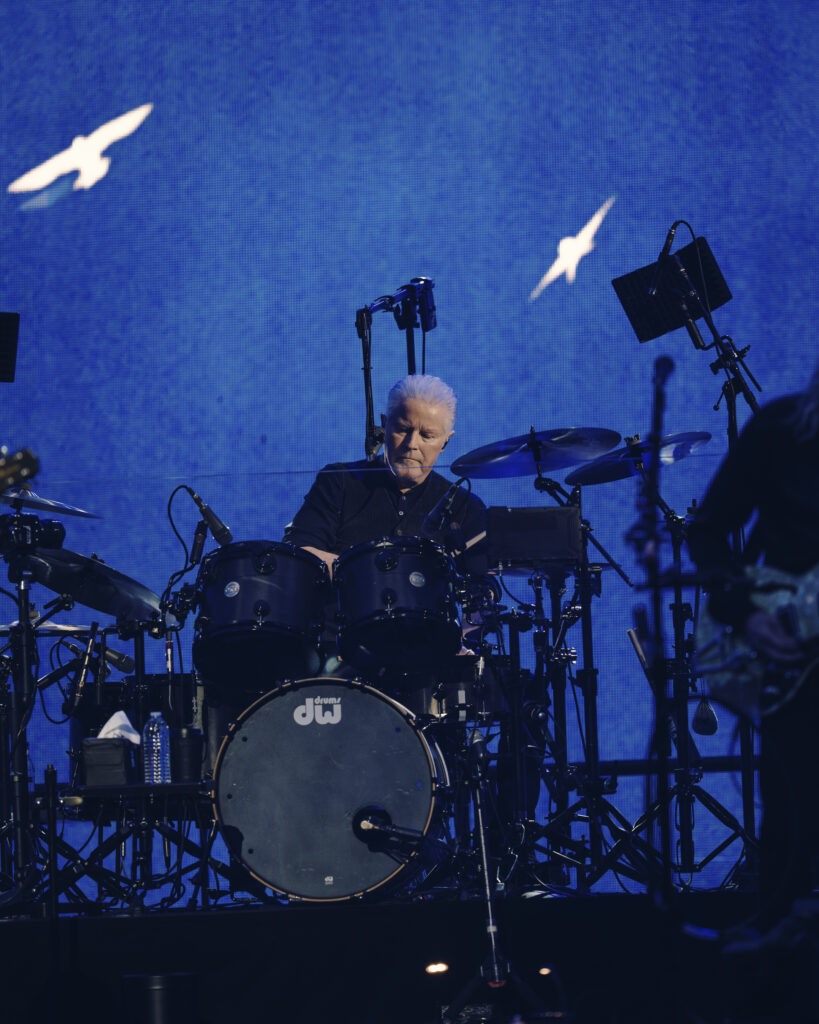
IAN SAINT: This last show in DFW will be the first hometown Eagles show for Chris Holt. Glenn Frey’s son, Deacon, will be participating; as will Vince Gill, whom I interviewed last summer for my NPR Ohio affiliate. Vince told me that “Desperado” is his favorite Eagles song to perform. What are the highlights of their performances for you?
DON HENLEY: They’re contributing a lot. Let’s start with Deacon, because he was the first to come in 2017. Deacon’s first show with us was at Dodger Stadium. I know he was petrified, but you couldn’t tell. He just stood up there and did it, and he’s just gotten stronger. [I’m proud] to see how confident he is, how much better he sings, and now he plays his father’s guitar solo on “I Can’t Tell You Why” on his father’s guitar. He’s got two kids of his own, now. So he’s come a long way, and it’s been a real treat to watch him grow into the role — and people love him.
Vince, of course, is Vince. I call him “the mayor of Nashville,” and he’s deeply loved here — he got a big ovation when we played here. He’s a pro’s pro, and he can do it all — he can play, he can sing, he fits in, and it’s been great having them both in the band. [Vince and Deacon] sing the songs that are best suited to their voices.
Chris, I met when he was my kid’s guitar teacher, but I didn’t realize what a big deal he was in Dallas. I mean, what a following he’s got in the scene there. Chris has been a great addition. He just stepped up and did it. Very unfortunate about Steuart Smith [retiring due to Parkinsonism] — he was a brilliant guitar player. But Chris just stepped right in like a pro and rose to the occasion. [Holt previously played on Henley’s 2015 solo album, Cass County, and toured with him.] Mike Campbell noticed him, but we get first dibs. [laugh] Mike gets him whenever he’s available for Mike. He has a lot more freedom with Mike — they can just jam — but with us he has to play parts, which he does well. It’s hard to find a guitar player who’s willing to play parts. We’ll let him jam out a little bit on “Seven Bridges Road,” he gets his bluegrass thing on — I didn’t even know he could do that, but he can. I think this version of the band is really good.
IAN SAINT: State Fair Records distributed the vinyl edition of Chris Holt’s album, Stargazer — which has you singing with him on “I’m Wasted” — and they are the ones that hire me to emcee the Cotton Bowl Plaza music stage at the State Fair of Texas.
DON HENLEY: Oh, really?
IAN SAINT: Yes. Now every time I see the Cotton Bowl, I’ll think of the Eagles playing there — among the other incredible rock memories there. I had my Buddy cover story with Nancy Wilson a few months ago — 48 years after she and Ann were Buddy’s cover story on the inaugural Texxas Jam — and we discovered the Cotton Bowl is where Heart met Van Halen for the first time.
DON HENLEY: Really? Wow, a lot of stuff has happened in the Cotton Bowl. There are all those beautiful, historic buildings in Fair Park built in the ‘30s. I go to the State Fair almost every year just to get a corndog. [laugh]
IAN SAINT: It’s funny you say that. State Fair Records has annual videos of me dancing to Sabor Puro’s cumbia music while eating a corndog.
DON HENLEY: [laugh] Well, the corndog is an important cultural [aspect of the State Fair]. You know the story of the Fletcher Brothers inventing it in 1942 and that whole thing.
IAN SAINT: Beyond the State Fair, are there other places in Dallas you like to go out?
DON HENLEY: I don’t get out much in Dallas. I’ve been to The Kessler a couple times.
IAN SAINT: Love The Kessler. Did you ever go to Sons of Herman Hall in Deep Ellum? The bones of that place and all its history, every time I step in, takes my breath away.
DON HENLEY: Yeah, I went there once. It’s great. So much history. One thing they haven’t torn down.
IAN SAINT: I believe the expression “Deep Ellum” was lost to the sands of time for a while. The Black factory workers in the neighborhood a century ago would call it that, hence the old “Deep Ellum Blues” song that the Grateful Dead eventually popularized. And then I think “Deep Ellum” came back as a popular term in the ’80s.
DON HENLEY: Yeah, it did. Deep Ellum goes through cycles when it becomes popular, then it becomes run down, and then it gets rehabbed again. I’ve watched it go around in circles for years. I like it down there. My friends have their great barbecue joint down there.
IAN SAINT: Oh, Pecan Lodge. They’re right down the street from me. I loved Deep Ellum as soon as I went there, because it reminded me of Cleveland. [laugh] It’s industrial, there’s such a wide variety of music and food concentrated there, and it’s very walkable.
DON HENLEY: Yeah, that’s one thing that Dallas has sort of preserved and not ruined yet. The history of that place, with Blind Lemon Jefferson, Lead Belly, T-Bone Walker, and all those Black blues guys playing down there…
IAN SAINT: They have a Blues Alley mural, depicting many of them, in Deep Ellum now. It’s near the Bomb Factory.
DON HENLEY: Okay, I know where that is. I’ve been there.
IAN SAINT: I interviewed Butch Vig when Garbage played Bomb Factory last fall. Butch told me that Garbage kicked off their first big tour in 1996 at the adjacent Deep Ellum Live.
DON HENLEY: I used to go to a [nearby] club in the ‘60s called The Cellar, and it was literally under ground. [Fascinating history of The Cellar clubs was chronicled in a 2000 Texas Monthly article. The Dallas spot was located across from the KLIF headquarters on Commerce St.]
IAN SAINT: Wow. Where in Dallas did you live in the ‘60s heyday?
DON HENLEY: I lived at Maple and Inwood.
IAN SAINT: That’s very close to Love Field Airport.
DON HENLEY: It’s a school now, but it used to be an apartment complex called the Eagle Apartments and all the bands lived there — the band that Jimmie Vaughan was in, The Chessmen, and two or three other bands. One of the bands, there was a guy named Cecil Cotten who was the lead singer [of The Briks]. He’s the first guy who gave me acid. [laugh] That was the summer [The Beatles’ 1967 album] Sgt. Pepper’s Lonely Hearts Club came out — so my first acid trip was at the Eagle Apartments, listening to Sgt. Pepper in my room with a black light.
IAN SAINT: Wow, it was really called the Eagle Apartments? That’s crazy.
DON HENLEY: Yeah. It had nothing to do with the name of the band. But there were a lot of great musicians. I remember Jimmie Vaughan and some of the other guys went to The Who concert, and they somehow got Pete Townshend to come back with them to the apartments. [laugh] I remember he was backed up into a corner of the apartment, we’re all standing around him asking questions, and he was holding forth about [adopts a British accent]“what an incredible invention the electric organ had been” and how that changed music and all that stuff. And we were all just standing there taking note. I was never a big Who fan; but those guys were, so they got Pete to come back over and rap with him. A lot of things happened in that apartment complex. I was sorry to see it getting torn down.
[It seems likely this Townshend visit was when The Who played Dallas on July 23, 1967 amid their first American tour, supporting Herman’s Hermits — whose singer, Peter Noone, I’ve interviewed for NPR in Ohio.]
IAN SAINT: What incredible shows did you go see there?
DON HENLEY: I did see Led Zeppelin at the Dallas, what’s it called? That horrible round building downtown, near the freeway.
IAN SAINT: Dallas Memorial Auditorium.
DON HENLEY: An acoustic nightmare, but I saw Zeppelin there on one of their early tours. [Henley is probably referring to their March 28, 1970 show supporting Led Zeppelin II.] I was at a club called Louann’s when Rod Stewart played there for the first time [with The Jeff Beck Group] in ’68 — Ronnie Wood was the bass player, I think Nicky Hopkins was there. [Records indicate keyboardist Nicky Hopkins hadn’t quite joined The Jeff Beck Group on tour yet, but Micky Waller was on drums.]
My little band with Richard Bowden, called Shiloh, opened at McFarlin Memorial Auditorium for a bill that included Spirit and Ike & Tina Turner — talk about a strange bill. I think [promoter] Angus Wynne used to bring [the Turners] in for shows, they played Dallas a lot. After we played our set, Richard said Ike Turner came over to him and said, “You better hang on to that little drummer boy because he can saaaang.” [laugh] That’s a mixed blessing.
We used to play the Studio Club in Dallas, on Preston and Northwest Highway. Larry Lavine had that club; he’s the guy who started Chili’s [restaurant] chain and then sold it.
IAN SAINT: That’s incredible. I also love the story of you and your bandmates fatefully meeting Kenny Rogers at a Dallas boutique store on McKinney Ave. in 1968. I looked up the video of Kenny and First Edition performing on “The Smothers Brothers Comedy Hour” earlier that year, and my jaw dropped. As someone whose first impression of Kenny was shaped by “The Gambler” and “Islands in the Stream” with Dolly, seeing Kenny in that 1968 phase of his artistry is jarring in contrast.
DON HENLEY: “I Just Dropped In (To See What Condition My Condition Was In),” which is a Mickey Newbury song. I had dinner the other night with Mary Miller, who used to be Mary Arnold — the girl who replaced Thelma Camacho, the original girl in the First Edition with Kenny Rogers. They had some kind of a falling out [with Thelma], they hired Mary and she was in the group until they quit and Kenny went solo. I hadn’t seen her in, like, 55 years, so she had some stories to tell — she talked about being on “Smothers Brothers” and some of the other things she did. It was great to see her.
IAN SAINT: You referenced the period before the corporate takeover of radio. That reminded me of your friend, DJ Jim Ladd, whom I corresponded with a bit before he died in 2023. Roger Waters said that Jim connected him with you about singing together on “Watching TV,” from 1992’s Amused to Death — probably Roger’s most acclaimed album since leaving Pink Floyd.
DON HENLEY: Oh, yeah. Jim was a piece of work. He was a fellow who would speak his mind and his heart, and he was a big supporter of ours. Roger is another guy who doesn’t mind speaking his mind.
IAN SAINT: I love that song, “Watching TV,” that conveys an empathy for the brave democracy protestors facing army tanks in Tiananmen Square.
DON HENLEY: Yeah, yeah. There’s another great song that Roger wrote, called “The Tide is Turning.”
IAN SAINT: Oh, that closes his previous solo album, Radio K.A.O.S. — Jim played the DJ character on that album. I think “The Tide is Turning” is probably the most uplifting closing song of Roger’s albums, whether solo or Pink Floyd; and I remembered he ended The Wall 1990 show in Berlin with that. I love that song.
DON HENLEY: I do, too. I haven’t seen Roger in a while, but I’m a fan of his.
[After recording “Watching TV,” Waters played Henley’s Walden Woods benefit concert at Universal Amphitheatre in 1992. Henley sang David Gilmour’s choruses in “Comfortably Numb.” Waters told Rolling Stone that the Walden Woods concert inspired him to tour again.]
DON HENLEY: Jim and I went to Washington together one time. We were speaking against radio consolidation. It was when Colin Powell’s son [Michael] was the head of the FCC. Jim and I sat in the office with him, and gave this whole spiel about radio becoming corporatized, homogenized, and being programmed from somebody’s office in New York — and the loss of regional independence and DJs losing the ability to play what they wanted to play. We quoted him the Tom Petty song about “The Last DJ,” and the guy just sat there and stared at us. He just did not connect at all. I’ll always remember that trip that Jim and I did together; and we did the best we could, but it didn’t have any effect. Of course, the corporations always win.
IAN SAINT: Well, I think people are waking up to how detrimental that corporate consolidation was. I think there’s been a little bit of a democratization since then, as far as the technological avenues to explore music that commercial FM radio won’t play.
DON HENLEY: Yeah. Lately, we’ve been working with SiriusXM. They’re putting the Eagles’ channel back up. They let me put together a playlist, and I got [my collaborator] Stan [Lynch] involved because he is a great DJ and I don’t have time. I can pick a playlist, but I don’t have time to DJ. My son can DJ. So yeah, there’s a little bit of it coming back. You’re right.
IAN SAINT: It’s interesting to see what older songs TikTok has popularized again, too. Stevie Nicks has been benefiting from that; Fleetwood Mac’s 1997 performance of “Silver Springs,” a Rumours outtake that is close to Stevie’s heart, has surged to her delight. Your duet with Stevie on Bella Donna, “Leather and Lace,” has also had some resurgence that way. I was listening to you and Stevie singing together, and you are doing the high harmony — which isn’t typical for the male.
DON HENLEY: That’s what I did on the record, yeah. I didn’t think about [the significance of] it. I don’t know if I can sing it now. Last time I sang it with her was when she was inducted to the Rock & Roll Hall of Fame as an individual artist [in 2019]. It’s a challenging song.
IAN SAINT: Another great collaboration I loved is you singing “More Life” with Randy Travis, shortly before his stroke. Randy is back on the road after his miraculous survival, and they’ve named it the More Life Tour. I interviewed Mary and Randy Travis for my NPR affiliate, and we opened the story with Mary’s memory of your great insight on the direction of that prescient song.
DON HENLEY: I’m so happy for him. I love the guy, and I think he’s one of the greatest voices in country music. That song really touched me. Mary is taking good care of him — they’re lucky she’s in his life.
IAN SAINT: Do you remember “the day the music died?” [When Buddy Holly, Ritchie Valens, and The Big Bopper perished in a plane accident on February 3, 1959.] Given The Big Bopper and Buddy Holly — our namesake — were Texans.
DON HENLEY: Yeah, I had their records. I never saw any of them live, but I remember their recordings and I remember the plane crash and that whole West Texas scene. Roy Orbison, Buddy Holly and The Crickets, Jimmy Gilmer of The Fireballs were from out that way.
IAN SAINT: I think JD Souther was born in Detroit, like Glenn Frey; but was raised in Amarillo?
DON HENLEY: Yeah, he was born in Detroit, but moved to Amarillo pretty soon after. Roy Orbison was a big thing for him.
IAN SAINT: There’s a lot springing out of West Texas lately. I just interviewed Solya from Abilene, and Treaty Oak Revival…
DON HENLEY: Oh, is West Texas where they’re from?
IAN SAINT: Yes, Odessa. I just had a Buddy cover story with Treaty Oak Revival, about their new album West Texas Degenerate.
DON HENLEY: Okay. Odessa is really, deeply red. [laugh] That’s Bush country.
IAN SAINT: Yep, they’re from Odessa. And they’re on a big arena tour, too — they’re playing Bridgestone Arena here in Nashville later this month.
DON HENLEY: Bridgestone, okay! Good for them.
IAN SAINT: Speaking of cover stories, you were Buddy Magazine’s April, 1985 cover story. At the time of our interview, you were preparing to shoot the music video for “All She Wants to Do is Dance.”
DON HENLEY: Wow!
IAN SAINT: You told Buddy that you were planning for “Sunset Grill” to be the basis of a 20-minute video. Did that come to fruition?
DON HENLEY: I don’t think so. That would’ve made a great video; but I don’t think I ever got around to that one, because it wasn’t really a single — so the record company wouldn’t have fronted any money for that. I’m trying to think what videos I did make…
IAN SAINT: I wondered, because not all of your music videos are on your official YouTube channel. Like your aforementioned debut single, “Johnny Can’t Read,” where you played Mr. Henley the school teacher.
DON HENLEY: Oh, yeah, I remember that one. I don’t think that is on my [official YouTube channel]. Yeah, Paul Gurian shot that on videotape. It didn’t look very good.
IAN SAINT: Well, the format was so nascent then.
DON HENLEY: Yeah. The best video is [1995’s] “The Garden of Allah.” Back in the Golden Age of Hollywood, there was a hotel at the corner of Sunset and Crescent [Avenues]. And it was run by a Russian woman, and her name was Alla Nazimova. People think it has something to do with Islam, and it doesn’t — it’s this woman, she called the hotel the Garden of Allah and there used to be wild parties there. Marlene Dietrich would swim nude [and her first Technicolor movie was 1936’s Garden of Allah.] Kirk Douglas is in the video, and he remembers the place. Charlie Chaplin hung out there. It was sort of the equivalent of the Beverly Hills Hotel.
IAN SAINT: I was just talking about Marlene Dietrich with Dionne Warwick. She was a great mentor to Dionne.
DON HENLEY: Oh, really? I had no idea.
IAN SAINT: Yes. Dionne’s first Top 40 hit was in 1962, so I suppose she launched right at the tail end of Hollywood’s Golden Age.
DON HENLEY: “The Garden of Allah” was a song for the greatest hits album [Actual Miles: Henley’s Greatest Hits]. They wanted extra cuts, so Stan and I wrote that. It was sort of about the O.J. Simpson trial and the miscarriage of justice. It’s sort of influenced by John Milton and Paradise Lost — about the devil who comes back — and The Master and Margarita by a Russian writer [Mikhail Bulgakov]. It’s a little bit like “Sympathy for the Devil,” The Rolling Stones’ song, and it’s an incredible video. Kirk Douglas is in it, and Jake Scott was the director.
IAN SAINT: Any collaborations that you’re proudest of?
DON HENLEY: Yeah, the one with Merle Haggard. [“The Cost of Living” on Henley’s 2015 solo album, Cass County.] We did that in Dallas, in my little home studio there. He was something else. Everything that came out of his mouth was like poetry when he would speak.
It took two sessions to get that done. The first one was in Nashville — he came into the studio and he didn’t really know the song, and we sort of got part of it. I think he was 77 then. He could still sing, but it wasn’t the same timbre that it used to be; but we got part of it. And I would speak to him through his bus driver, who was his liaison to the outside world — because the manager was so old. Once we realized we didn’t really have the whole vocal, I called his bus driver and said, “I hate to bother you, but could Merle maybe come back and try this again?” He goes, “Yeah, I’ll get him to come back.” So several months went by…
First of all, I’d hired Merle to play in my hometown at the little theater [Music City Texas Theatre] that they have there — this was [several years] before he did the song with me. It used to be the American Legion Hall, built in 1950. It’s where my career started, and they turned it into a small music venue. All my friends went and played there — Vince Gill played there, Jackson Browne played there, I think JD Souther played. So I said, “I want Merle Haggard to play here.”
It’s not on a major interstate or anything like that; it’s really out of your way. So I think he had played in Shreveport, and he was going to play in Dallas next. I paid $35,000 for Meryl to come and play at that place. [smile] I had just gotten home from tour in Dallas, and I drove all night to get there so I could sit in the back and watch him. [Read the Texarkana Gazette article about Merle’s 2008 show in Linden here.]
[Afterwards] they said, “You want to go and meet Merle? He’s on the bus.” And I went, “Yeah,” because I hadn’t met him — I just watched him from the back of the auditorium, it only holds like 400 people. I got on the bus, and the bus driver said, “Merle’s in the back.” I go back there and there’s this cloud… I mean, this is the guy who did “Okie from Muskogee,” which opened with “We don’t smoke marijuana in Muskogee.” [laugh] And it wasn’t even marijuana — it was fucking hash!
So I went back up to the front of the bus. Merle came up and he sat down, and the bus driver goes, “Meryl, this is Don. He’s in the Eagles.” And Merle goes, “Well, y’all do some kind of Eagles tribute thing or something?” [laugh] Because he couldn’t believe that a guy from the Eagles was from a place so rural. And they went, “No, he’s actually in the group.” He goes, “Oh, okay.” And we had a brief conversation.
Cut to several years later in Nashville, he came in and did part of the song. At one point he said, “I’ve got to go take a break. I’ve got to go put some stick-em on my teeth” — he had a plate. I don’t know if that was a joke, or if he actually had to firm them up because they were maybe rattling when he was singing.
Cut to the next [session]. I’m in Dallas; he’s on his bus, coming from Austin to play at Billy Bob’s in Fort Worth that night. He stops by the house, and he’s got his wife and son — who’s his guitarist — and the bus driver and somebody else. The bus driver comes over to me, and I said, “Does he know the song now?” He said, “Yeah, he’s been listening to it all the way up here from Austin. He thinks it’s a good song, and he likes it.” Okay, great.
The first thing Merle tells me: “Don, what’s happened to the music?” He’s talking about country music. I go, “I don’t know, Merle. It’s come too far from the church and the cotton patch, I guess.” And he said, “Yeah, it’s just not right. But this is a good song.”
So he goes in, he still doesn’t really know the song. [laugh] He’s got the lyrics there in front of him, and I’m coaching him the melody — I’m sitting there at the board [thinking], “I’m telling Merle Haggard what to sing.” We did about 15 takes, and he comes storming into the control room and goes, “Is this some kind of a fucking joke?” I go, “No, sir. I’m just trying to get us a Grammy nomination.” He goes, “Well, I believe you boys are looking for a younger man.” Stan nudges me and he goes, “That’s a great song title.” [laugh] So there’s a song on my country album, Cass County, called “A Younger Man” from that line. [“The Cost of Living” did wind up earning a 2016 Grammy nomination for Best American Roots Song.]
Then I get a call from the bus driver a few months later, saying, “You need to give Merle something for that work he did. There’s a bootmaker in El Paso that makes really nice cowboy boots. You should get him a pair with eagles on them or something like that.” I said, “How about if I just give him cash?” He said, “Well, that’ll work too.” [laugh] I forget what I gave him, but those country people have a different way of doing stuff.
IAN SAINT: Merle had a good point about where the country music industry was at the time, with the “bro country” wave back then, versus how it was when he started.
DON HENLEY: Merle’s still got a sister in Oklahoma. [Sadly, Lillian Haggard died in October, 2024 at age 103.] They were Dust Bowl people. It was really interesting being around him, because everything he said was like a lyric or a poem, except “Is this some kind of fucking joke?” [laugh] He was pissed we’d made him do so many takes, and he wasn’t used to that.
But it was the best work he’d done in a while. We computer-ed it together and I’m proud of that. My voice doesn’t stand up to his. He said at one point, “You want me to sing softer because you’re singing softer?” And I said, “If I could sing like you, sir, I would; but this is my voice. I want you to sing like you; I don’t want you to try to match me. “
So that was one of the most memorable things — that, and doing the background vocals for Randy Newman. That was so much fun. We just laughed and laughed, because he’s so funny. “No, no, you want it to sound more like me — like a water buffalo.” [laugh]
IAN SAINT: Your hard-won Merle collaboration got me thinking about Bobbie Gentry. I interviewed Reba McEntire on the ACM Awards red carpet when she hosted last year, and I told Reba that the last public appearance Bobbie Gentry — who first wrote and recorded “Fancy” — made was the ACM Awards in 1982. Reba had a huge hit with “Fancy” in 1991, and she has never been able to get in touch with Bobbie via any form of communication.
DON HENLEY: Yeah, I tried to get in touch with her. I wanted to sing with her; I had a song that I thought would’ve been perfect for us, and I loved her — I thought her voice was just incredible. I met some guy who claimed he was her business manager, and he said, “Oh, I can put you in touch with her.” So I think he gave me an email address or something… crickets, nothing.
IAN SAINT: Did you ever encounter Bobbie back in the day?
DON HENLEY: No. I think she used to live outside of Memphis, but the last thing I heard was she’s living in LA. She married Bill Harrah, but that didn’t last very long. [Their 1969 marriage lasted 4 months.] I went back to the guy and said, “She’s not getting back to me. ” He said, “Okay, I’ll get her to get back to you.” And it never happened.
IAN SAINT: Well, if it’s any consolation, Reba probably made Bobbie a royalties fortune by covering “Fancy” — and Reba has never gotten through to her.
DON HENLEY: She’s into being a hermit, I guess. I just saw Reba; she came to see us in Vegas. She’s the real thing. Her and Dolly are the real thing.
The other memorable highlight of my recording career was the duet with Dolly Parton. She showed up at the studio dressed to the nines, and looking great. I played her the track of the song we had recorded — The Louvin Brothers’ “When I Stop Dreaming” — and she said, “Oh, I know that song. Me and Porter [Wagoner] used to do that one.” She did one take and said, “Well, that key is a little high for me, but I guess I’ll just have to rare back and get it,” which she proceeded to do in only two more takes. She was flawless… no nonsense, but sweet as pie. I have tremendous respect for her.
IAN SAINT: I love that the album named after your home county, Cass County, is home to all these dreamy collaborations. It’d be interesting if you teamed up with “Weird Al” Yankovic — did you know that he parodied “Desperado”? He used to perform a medley of food parodies, which included “Avocado.” [Al resurrected “Avocado” for his segment with William H. Macy.]
DON HENLEY: I’ve heard about that, yeah. I just saw him on a talk show the other night. I think he’s great.
IAN SAINT: I interviewed Al for NPR in Ohio last fall. He’s really timeless — Buddy Magazine had a cover story interview with Al in 1988.
DON HENLEY: Is Kirby Warnock still involved in this thing? [Kirby was an editor for Buddy in the ‘70s and ‘80s.]
IAN SAINT: Yes, I just spoke to Kirby this weekend. He told me about you narrating his first documentary, 1996’s Return to Giant, about the 1956 film Giant [starring Elizabeth Taylor, James Dean, and Rock Hudson] filming in Marfa, Texas. Crazy enough, the Texas Theater just hosted a 30th anniversary screening of that yesterday.
DON HENLEY: Oh, really?
Don’s publicist, Larry Solters, asked if I knew what the Texas Theatre is known for.
IAN SAINT: Oh, yes. That’s where Lee Harvey Oswald was apprehended.
DON HENLEY: I have a perverse friend in Dallas, you may know him. Seth Smith started a club about 20 years ago called Lee Harvey’s. [laugh] I go, “You sure you want to do that?” He goes, “Yeah, people love it.”
IAN SAINT: Oh, yes, I’ve been there many times. It’s an interesting place. That’s where State Fair Records has their “all hands” staff meetings before we load in for the State Fair of Texas.
DON HENLEY: My first band gig, by the way, was at the local Chevrolet dealership in Linden in 1963 — for the coming out party of the ‘64 Chevrolet.
IAN SAINT: So your first Texas gig was the Chevrolet dealership in your hometown in ‘63, and then your last Texas gig is headlining the Texas Rangers’ stadium 63 years later. That’s an amazing story arc.
Speaking of story arcs: thank you for sitting with me for nearly 2 hours, for a Buddy Magazine cover story 41 years after your first Buddy cover story in 1985. And thanks for your support of Buddy over the decades.
DON HENLEY: Thanks for coming out here. I read your Andy Summers story — that was a trip, I learned a lot.
IAN SAINT: Oh, thank you very much for reading — that was my first Buddy cover story. I hadn’t realized that Andy was in his mid 30s when he joined The Police, and did stints in the ‘60s with The Animals and Soft Machine.
DON HENLEY: Me, neither. He was 34. I didn’t know [about Andy’s tenures in those ‘60s bands], either, until I read your article — I learned a lot of stuff.
IAN SAINT: Well, thank you; I’m delighted that you enjoyed it. I learned tons of stuff about your incredible journey in this interview, and can’t wait to publish this before the Eagles wrap their Long Goodbye on your home turf.
DON HENLEY: See you then. Safe travels.
For tickets to the Eagles’ concert at Globe Life Field, with support from Tedeschi Trucks Band, visit https://globelifefield.com/event/eagles-20260516/. For a calendar and tickets to the Eagles’ dates at the Sphere, visit https://eagles.com/.
To support Buddy Magazine‘s digital archiving project of pre-Internet stories like our 1984 and 1985 interviews with Don Henley, visit https://www.gofundme.com/f/help-preserve-50-years-of-tx-music-history-w-buddy-magazine


